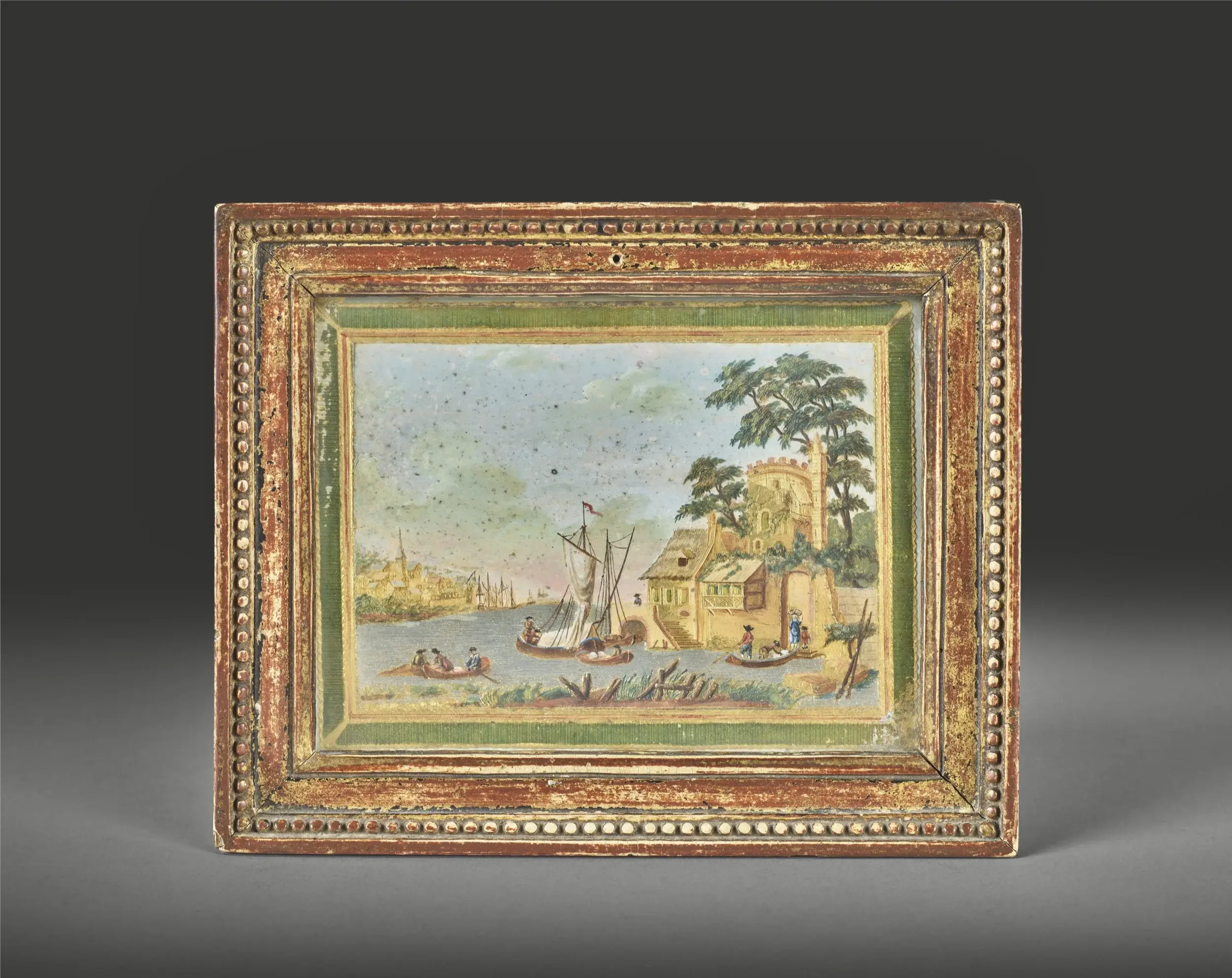
Compigné painting depicting a view of the surroundings of Francfort-sur-le-Main
- Description
- Histoire
France, last third of the xviiith century
Attributed to Thomas Compigné
Tin, gold
Gouache and colored varnish
Height: 18.5 cm – 7 3⁄8 inches
Width: 22.5 cm – 9 inches
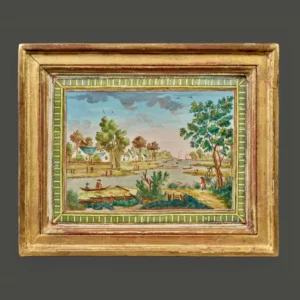
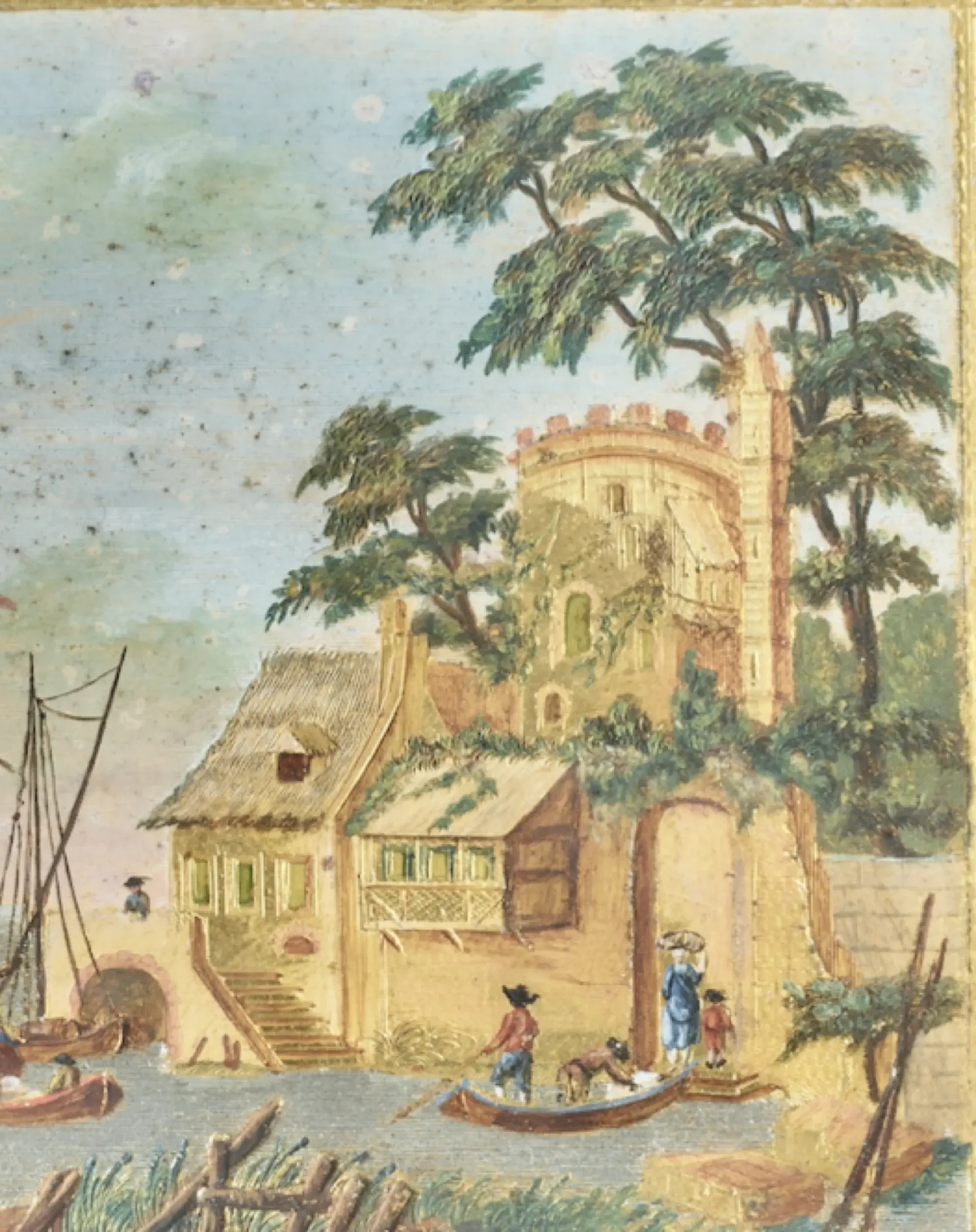
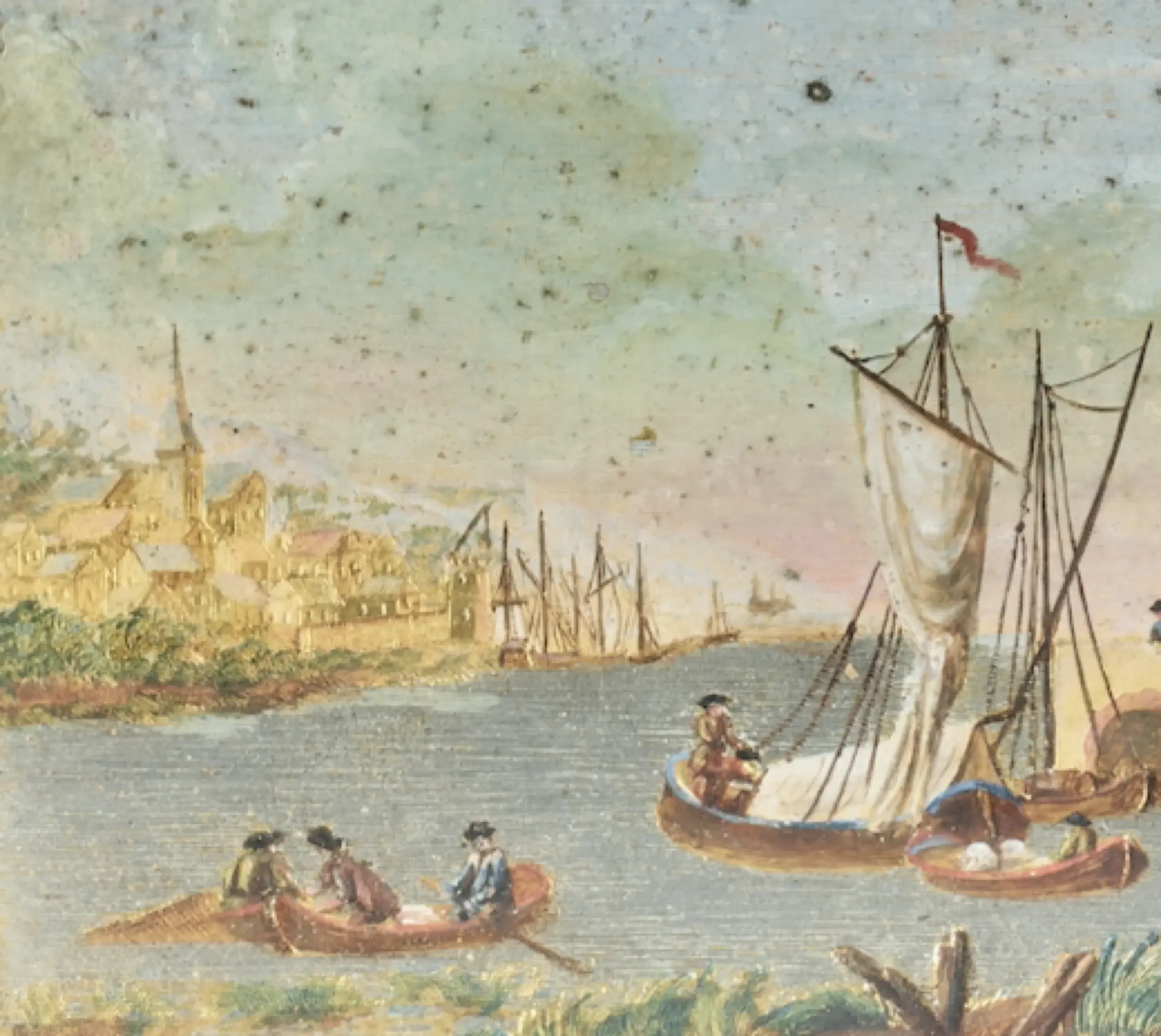
The scene, executed in gouache and heightened with gold, is painted on an embossed tin sheet. The composition represents a landscape near Frankfurt am Main. In the foreground, a narrow bank with wooden fences faces a body of water animated by several boats, including sailing vessels. Figures can be seen navigating or busying themselves near a house set directly on the riverbank. This dwelling features half-timbering, a tall roof, a turret, and stairways descending straight into the water. Behind it, a garden is suggested, marked by a tree rising above the rooftop and visible in the distance. On the opposite bank, a village unfolds. The spire of a church rises above the rooftops, while other sailing boats glide along the shoreline. The river stretches into the depth of the scene, leading the eye toward a horizon that meets a sky tinged with soft pink and blue hues, evoking the break of day. Certain architectural details are delicately highlighted with gold. The whole is bordered with a green and gilt edging, and set within a broad moulded frame adorned with a beaded frieze.
The Compigné Process: Engraving, Stamping, Polychromy
The small paintings executed on tortoiseshell or tin, commonly known as “Compignés,” are named after Thomas Compigné, a Parisian craftsman active in the second half of the 18th
century, established on rue Greneta. Although his name is closely linked to this type of production, it is not certain that he was their sole creator. These works, precious in both material and execution, demonstrate technical mastery in combining engraving and painting. The study of the painting under analysis offers an opportunity to better understand this singular production.
The creation of a Compigné piece begins with a lathe-engraved matrix—central to the entire process. The craftsman incises the key elements of the composition into this bronze matrix using a guilloché lathe, usually inspired by an existing print. This use of printed models ensures consistent imagery while allowing variations during the coloring phase. The matrix, made of bronze for durability, allows for multiple stampings. The relief is rendered with remarkable finesse, especially visible in guilloché areas like water or architectural features, which resemble embroidered or moiré fabric textures. In both paintings analyzed, this work is perfectly exhibited and attests to a high level of technical mastery.
Compigné used two types of support: tortoiseshell and tin. Tortoiseshell, softened in a boiling water and oil bath, is pressed against the matrix to retain the relief. Tin, being more malleable, allows a faithful reproduction without damage. The present piece is made of tin, as shown by the texture, thickness, and precision of stamping. After stamping, the surface is painted with gouache—an opaque water-based paint. Color combinations and gilding vary according to the artist’s inspiration; skies, for instance, often differ between versions. Human figures, generally absent from the matrix, are added in gouache, and vary in number, position, and dress. Gilding, often used in Compigné works, was likely applied with a brush using gold gouache (a mix of gum arabic and powdered gold). This technique, safer and more precise than mercury gilding, allows for detailed work. For larger areas like frames, gold leaf may be used.
Variations and Interpretation of Engraved Models
The composition of the work examined here is based on an 18th-century engraving: Les Environs de Francfort sur le Main, executed by Jean-Jacques Leveau after a work by Franz Edmund Weirotter (1733-1771), an Austrian painter. This print, held by the Museum of Art and History in Geneva, is reproduced by the tabletier in its general structure, although the transfer onto a metal matrix results in a reversal of the motif. The subject is mentioned in an advertisement published by the tabletier in L’Année littéraire in 1770, confirming the interest he took in including such topographical views in his decorative repertoire.
Certain elements, such as figures, architectural features, or vegetation, were shortened, modified, or deliberately omitted during the engraved transfer onto the tin sheet. Owing to the process employed, each example of the same model displays its own distinctive characteristics. The gouache highlights, applied by hand to each piece, introduce notable variations. In the example under consideration, Thomas Compigné adds a garden behind the house and removes the depiction of the dilapidated arch that appears in the original engraving.
Thomas Compigné drew on a wide range of subjects for his paintings. He found inspiration in current events, fashionable themes, and the particular requests of his clientele. Several compositions evoke contemporary events, such as the inauguration of the new Pont de Neuilly or the charitable act of the Dauphine in 1773. Others accompany the completion of major building projects. In 1772, at the conclusion of the works directed by Ange-Jacques Gabriel at the Château de Saint-Hubert, Compigné executed two views of the residence intended to be presented to the king.
The iconographic sources used are numerous. They comprise of French prints after Caude Joseph Vernet or Pierre-Antoine Baudoin, as well as models of foreign origin, notably after Canaletto or Aert van der Neer. Several compositions also derive from the series of the Maisons royales de France engraved by Jacques Rigaud, including the Tuileries Palace, the Luxembourg Palace, and a view of Paris from the Pont Royal. This corpus is referred to in workshop documents as “Landscapes, Seascapes, Architecture”, to which are added a few scenes classified as “historic subjects”.
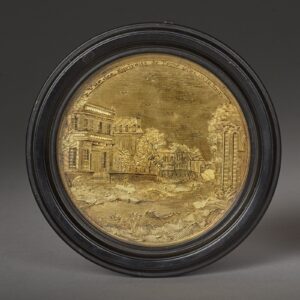
Initially small in format, Compigné’s paintings were conceived for collectors’ cabinets. In a later phase, the adopted larger dimensions. These enlarged versions were accompanied by decorated frames and intended for receptions rooms. Certain motifs were transposed into circular medallions or conceived directly in this format. These medallions, integrated into luxury objects such as snuffboxes, were often separated from their original supports. In some cases, they were conceived from the outset as autonomous pieces or sold individually in Compigné’s shop to meet specific commissions.
Despite the absence of exhaustive documentation on this body of work, pieces executed using this technique are generally attributed to the workshop of Thomas Compigné or to his circle. Their attribution, however, remains subject to verification. The study of the quality of execution, formal rigor, and adherence to engraved compositions makes it possible to isolate works produced directly by the tabletier’s hand. In the present case, the delicacy of the highlights, the modulation of contrasts, and the stylistic continuity support an attribution to Thomas Compigné himself.
Thomas Compigné
Although Thomas Compigné’s works fascinated art collectors in the late 18th century, the man himself remains poorly documented. Some 20th-century authors suggested Italian origins based on orthographic variations of his name (Compigni, Compignié, Compigné), but no definitive proof exists.
His biography begins around 1750 in Paris, in the Temple district—a special area granting artisans certain privileges, including exemption from guild restrictions. In 1756, he moved to rue Greneta, under the sign of Roi David, where he remained until at least 1778. Both craftsman and merchant of his own creations, he enjoyed great success, peaking in the early 1770s.
As a tabletier (luxury goods maker), he specialized in boxes, game boards, snuffboxes, cane handles—crafted from blonde tortoiseshell inlaid with gold, ivory, exotic woods, or mother-of- pearl. These pieces required high skill in marquetry, metal chasing, ivory carving, and turning. Precious materials added to their appeal. His production catered to Parisian tastes for refined and technically complex objects.
Compigné is one of the few 18th-century tabletiers whose name endures, partly because he signed many of his works, which was unusual at the time. Several bear the inscription “Compigné, tabletier du roi,” often with the subject and technique noted, such as “executed on the lathe.”
Between 1762 and 1773, he developed several innovations: in 1762, a method for coloring tortoiseshell; in 1766, mourning snuffboxes in black shell; and in 1773, scented boxes for tobacco. In 1765, he began using his turning lathes for decoration, leading to the so-called “Compignés”: tableaux and medallions on tortoiseshell or colored gold.
His renown increased steadily in Paris from the late 1760s, and between 1766 and 1773, several gazettes praised his creations as "very beautiful, inlaid with gold and vivid colors." During this period, he had the honor of presenting his works at court on multiple occasions. On 3 August 1772, he showed two medallions at Compiègne, representing views of Versailles and Paris seen from the Pont Royal. On 14 December of the same year, he presented two tortoiseshell tableaux at Versailles, both depicting views of the Château de Saint-Hubert. A year later, on 19 December 1773, he unveiled a new composition at court entitled Les Malheurs réparés par la Bienfaisance. Finally, on 9 October 1774, he presented two allegorical works to a member of the royal family: Joyeux avènement de Louis XVI au trône and L’Ombre d’Henri IV montrant au roi le chemin de la gloire.
In recognition of his skill and contribution to the decorative arts, he was officially appointed tabletier du roi in 1773. A public notice from 1776 further indicates that he was granted a royal pension. Among his distinguished clientele were prominent figures from the royal court, including Madame du Barry. The success of Compigné’s career can be attributed to the originality of his creations, the versatility of his techniques, and the diversity of his thematic repertoire. His works often responded to contemporary events and fashionable tastes—for instance, allegorical boxes commemorating the Dauphin’s wedding in 1770, a mourning snuffbox marking the death of Louis XV in 1774, and medallions celebrating the accession of Louis XVI.
After 1774, no new subjects were recorded in relation to his engraved tableaux, and his activity appears to have declined after 1775. Nevertheless, his most iconic works remain the highly detailed representations of cities, monuments, and châteaux, often embedded within animated landscapes. Their precision, topographical accuracy, and rich decorative effects firmly situate his oeuvre within the refined tradition of 18th-century Enlightenment decorative arts.
Bibliography
-
“Les Compignés et leurs créateurs, ces délicats chefs‑d’œuvre de la tabletterie au XVIIIe siècle”, Plaisir de France, no. 427, March 1975.
-
Compigné, peintre et tabletier du Roy, exhibition catalogue, Grasse, Villa-Musée Jean-Honoré Fragonard, June–July 1991.
-
Fréron, L’Année littéraire 1770, Vol. VI, October 30, 1770, p. 215.