
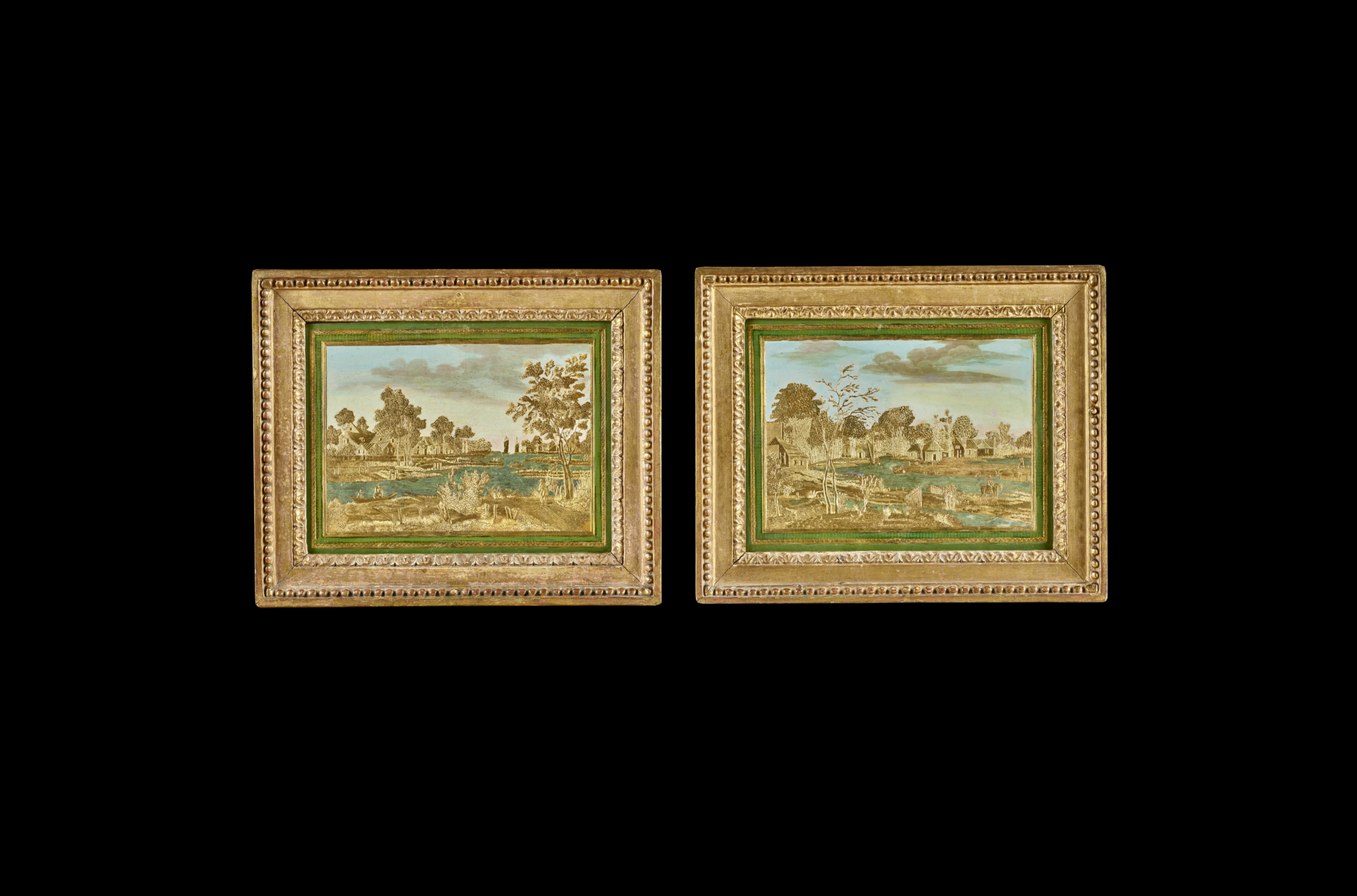
Pair of rectangular paintings in compigné representing a riverside landscape
- Description
- Histoire
France, second half of the xviiith century
Attributed to Thomas Compigné
Pewter, gold leaf and silver
Gouache, colored varnishes
Height: 12,5 cm – 5 inches
Width: 17 cm – 7 inches
Comparable works
- Attributed to Thomas Compigné, View of the Ypres Canal at Furnes, second half of the 18th century, Galerie Léage collection.
- Attributed to Thomas Compigné, Pair of Compigné panels, View of the Surroundings of Utrecht and View of the Ypres Canal at Furnes, second half of the 18th century, Galerie Léage collection.
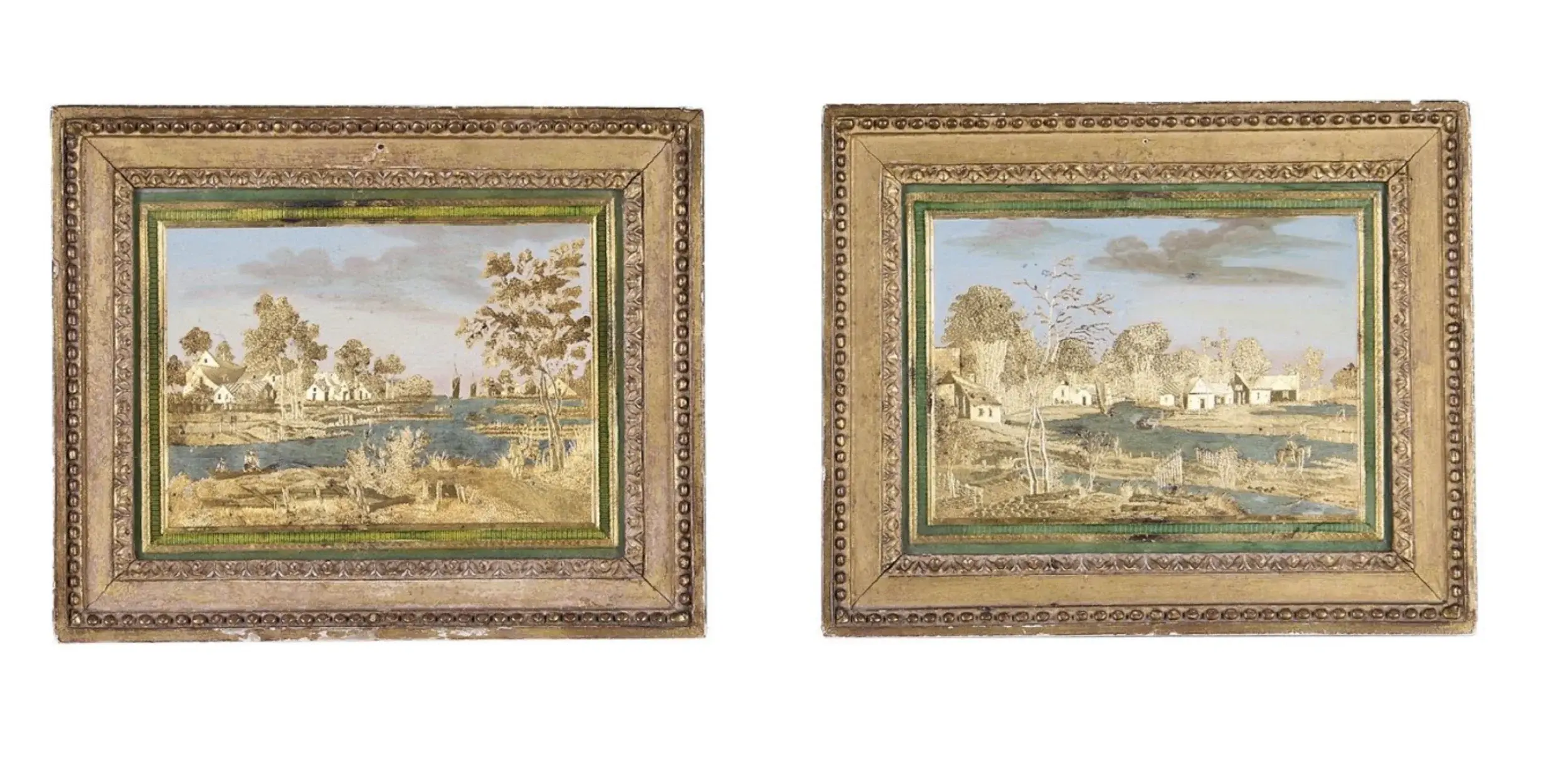
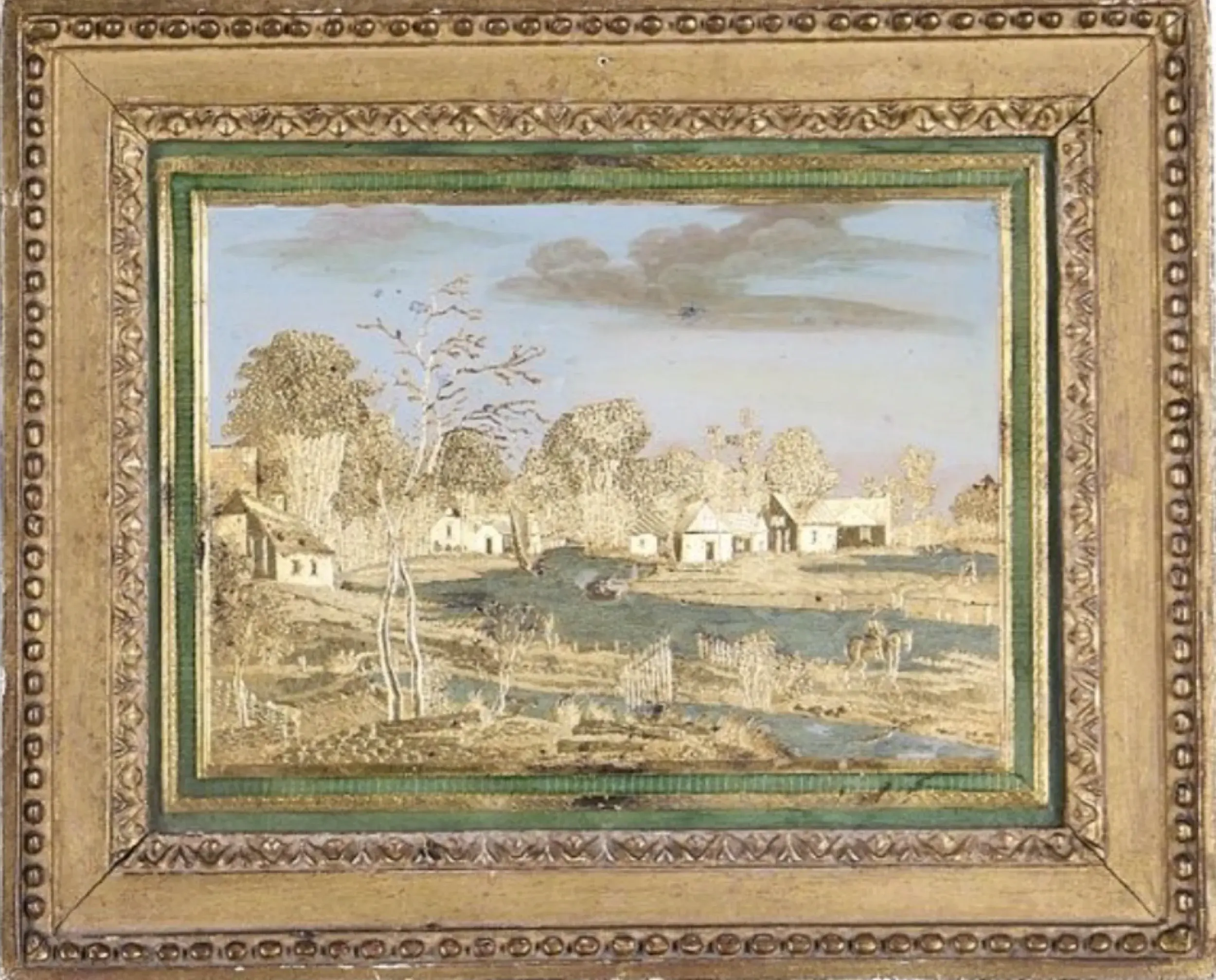
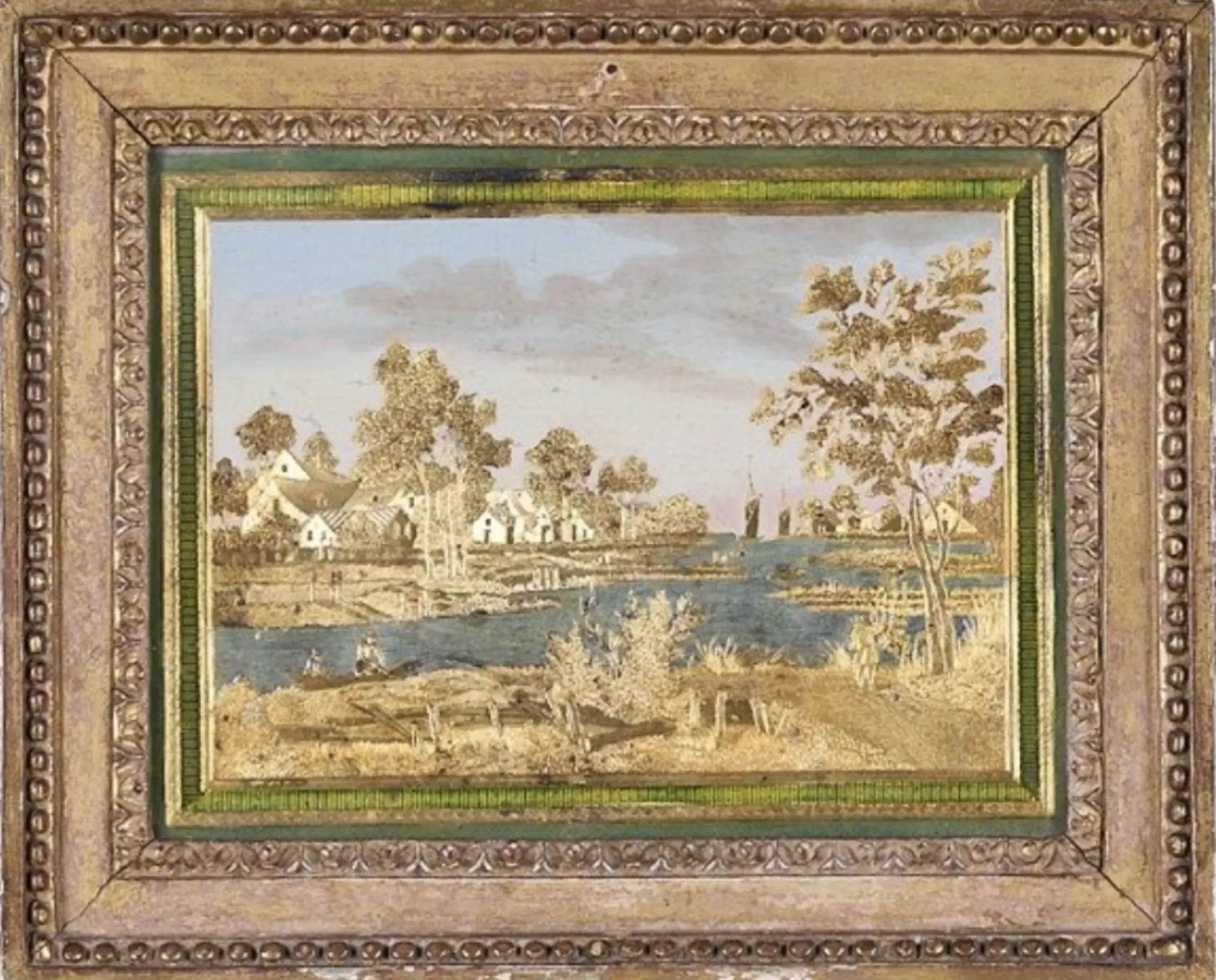
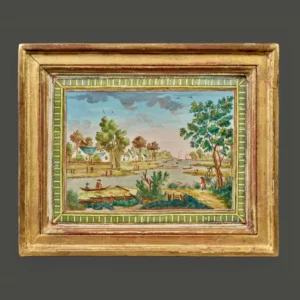
This pair of Compigné paintings depicts two riverside landscapes, animated with figures navigating on the water. Rectangular in shape, each work is executed on a sheet of stamped tin, enhanced with silver, gold leaf, and gouache. This skillful blend of materials creates a perfect union between painting and engraving. In the first painting, the scene shows, in the foreground, the winding bank of a river. A solitary figure, standing with his back turned, gazes at the water stretching into the distance. The horizontal silver-toned lines used to depict the river evoke a flat and tranquil surface. Two men are busy bringing their boat to shore. On the opposite bank to the left, a hamlet emerges, while two sailing boats appear in the distance. Another hamlet, similar to the first, can be glimpsed through sparse vegetation. The second painting offers a similar scene. Three calm bodies of water, separated by winding banks, structure the composition. On one, a horseman rides across the scene. On another, a figure seen from behind walks along the riverbank. In the background, a hamlet rises amid lush vegetation. A sailing boat and another vessel moored along the banks complete the view. Touches of gold in varied tones highlight certain details, creating contrasts and shadows that give the whole a delicate relief and subtle shimmer. The skies, painted in gouache in soft bluish-pink hues, reflect the gentle colors of a late afternoon. This chromatic range transitions harmoniously from rose to the deeper greys of the clouds, with birds flying overhead. Each painting is set in a frame decorated with gold borders, a pearl frieze, and waterleaf motifs.
The Creation Process of Compigné Panels: Engraving, Embossing, Polychromy
The small paintings on tortoiseshell or tin, commonly known as “Compigné,” owe their name to Thomas Compigné, a Parisian tabletier active in the second half of the 18th century and established on Rue Greneta. Although this type of work is associated with his name, it remains uncertain whether he was their sole creator. These pieces, both precious in material and meticulous in execution, demonstrate a remarkable command of techniques that merge engraving and painting. The study of the present pair offers insight into this distinctive production.
The creation of Compigné paintings relies on a metal matrix engraved on a lathe, which forms the cornerstone of the technique. The tabletier begins by engraving the primary elements of the composition into the matrix using a rose engine lathe, typically based on a pre-existing print.
This use of printed models ensures compositional consistency while allowing for variation during the coloring phase.
The bronze matrix, robust enough for multiple impressions, renders relief with exceptional finesse, particularly evident in guilloché areas such as water surfaces and architectural elements, whose textures resemble embroidery or moiré fabric. In the present panels, this craftsmanship is discernible and attests to a high level of technical expertise.
Compigné employed two types of supports: tortoiseshell and tin. The tortoiseshell was softened in a bath of boiling water and oil before being pressed onto the matrix to retain the relief. Tin, being more malleable, allowed for faithful reproduction of the design without risk of damage. The two works under study were executed on tin, as evidenced by the texture, thickness, and uniformity of the embossing.
Once the matrix was impressed, the surface was painted with gouache, an opaque and covering water-based paint. The use of color and gilding varies according to the artist’s inspiration. For instance, skies may differ significantly from one version of a composition to another. Human figures, often absent from the original matrix, are added in gouache; their number, position, and attire vary between examples.
Gilding, frequently found in Compigné works, was likely applied with a brush after embossing, using gold gouache made of gum arabic and gold powder. This technique, preferred over mercury gilding (which was more hazardous and required heat), allowed for great precision in detailing. For larger areas such as frames, gold leaf might have been employed.
Variations and Interpretations of Engraved Models
The compositions of the two works discussed here reproduce two 18th-century engravings after Aert van der Neer: one engraved by James Mason, held at the British Museum (Vue des environs d’Utrecht, ca. 1750–1783, inv. 1861,1109.184), and the other by Jean-Jacques Leveau, housed at the Harvard Art Museum (View of the Ypres Canal at Furnes, inv. R3941). These sources are followed in their general structure, although transferring the image to a metal matrix results in a mirrored image.
In Leveau’s engraving, the setting sun is the focal point. Its light organizes depth through backlighting and iridescence on the water’s surface. This luminous principle is absent in Compigné’s version, where the sun disc is deliberately omitted. Nevertheless, the landscape retains lateral lighting, suggesting the sun’s implicit presence in the scene.
Thomas Compigné selected a wide range of subjects for his works, drawing inspiration from current events, popular themes, and the specific requests of his clientele. He also produced works on commission. Many of the themes depicted relate directly to recent occurrences. Some scenes commemorate contemporary events, such as the inauguration of the new Pont de Neuilly or the Dauphine’s charitable act in 1773. Others mark the completion of major projects; in 1772, upon the conclusion of Gabriel’s works at the Château de Saint-Hubert, Compigné created two views of the residence, which he presented to the king.
His iconographic sources are diverse. They include French engravings after works by contemporary artists such as Claude Joseph Vernet and Pierre-Antoine Baudouin, as well as foreign models, particularly after Canaletto and Aert van der Neer. Compigné also drew from Jacques Rigaud’s engravings in Maisons royales de France, featuring the Tuileries Palace, Luxembourg Palace, and a view of Paris from the Pont Royal. This broad repertoire was referred to by the artist as “Landscapes, Marine Views, Architecture,” with a few compositions falling into the category of “historical subjects.”
Created in small formats for collectors’ cabinets, Compigné’s panels later evolved into larger formats, complete with decorative frames, intended for more spacious rooms. Some motifs were transposed into circular medallions or conceived as such from the outset. These medallions, mounted on snuffboxes or other luxury items, are often found today separated from their original mounts and regarded as autonomous works. Some were likely conceived with this purpose in mind, or offered as standalone, adaptable models in Compigné’s boutique.
A label dated 1933 is affixed to the back of this pair, attesting to the interest these works attracted from early 20th-century museum curators and shedding light on the state of scholarship at that time. For a long period, these paintings remained understudied, both in terms of their authorship and technique.
Although many aspects of this production remain understudied, works executed using this technique are today generally attributed to the workshop of Thomas Compigné or his close circle. Not all can be confidently attributed to him. However, the quality of execution, precision of detail, and fidelity to known compositions help distinguish works directly from his hand from those produced by followers. In the present case, the remarkable finesse of the highlights, the subtlety of the contrasts, and the stylistic coherence support an attribution to Thomas Compigné himself.
Thomas Compigné
Despite the enduring fascination his works have held for connoisseurs of decorative art since the late 18th century, Thomas Compigné himself remains an elusive figure. Over the past thirty years, some scholars have proposed an Italian origin—an assumption based solely on orthographic variations in historical documents, where his name appears as Compigni, Compignié, or Compigné, amid a broader context of inconsistency in the spelling of surnames. No conclusive evidence confirms this lineage, and his origins remain uncertain.
The earliest biographical records for Thomas Compigné are dated around 1750, when he is documented as working in Paris, within the Temple enclosure. This district offered certain privileges, as it operated under a special status: that of royal artisan. In the 18th century, the Temple was among the few areas in Paris exempt from the guild system enforced throughout the capital. In 1756, he moved his workshop to Rue Greneta, at the sign of Roi David, an address he still occupied in 1778. As both manufacturer and vendor of his production, he developed a flourishing business that reached its peak in the early 1770s.
Practicing the profession of tabletier, Compigné specialized in crafting and selling luxury objects: boxes, backgammon, checkers, and chess sets, snuffboxes, and cane handles made of blond tortoiseshell inlaid with gold. These items, executed with meticulous care, showcased mastery of a wide range of techniques such as wood or mother-of-pearl marquetry, ivory carving, lathe turning, and metal chasing. The choice of materials further enhanced their precious character: gold, silver, inlay, molded or gold-piqué tortoiseshell, ivory, native and exotic woods. This production catered to the Parisian taste of the period for refined and technically sophisticated objects.
Thomas Compigné is among the rare 18th-century tabletiers whose name has been preserved, particularly because he took the unusual step—early in his career—of signing a significant portion of his works. This initiative was uncommon at the time. Several of his pieces bear the inscription “Compigné, tabletier du roi,” sometimes accompanied by a description of the subject and mention of the technique, such as “turned on the lathe.”
Between 1762 and 1773, he developed several new processes. A technique introduced in 1762 appears to have allowed the coloring of tortoiseshell in various hues. In 1766, he produced mourning snuffboxes in black tortoiseshell. In 1773, he designed boxes that could perfume the tobacco they contained. These innovations reflect his ongoing research in the decorative arts. Beginning in 1765, he developed an original technique using tabletier lathes, initially applied to the decoration of snuffboxes. This invention gave rise to a series of objects now known as “Compigné”: panels and medallions executed on tortoiseshell grounds or composed of colored gold alloys.
Compigné’s fame in the capital grew from the late 1760s. Several gazettes praised the quality of his work between 1766 and 1773, describing objects as “very beautiful, inlaid with gold and various highly durable colors.” He gained recognition when he presented his works at court on several occasions. On August 3, 1772, he submitted to the king and royal family, then in residence at Compiègne, two medallions depicting a view of the Château de Versailles and a view of Paris from the Pont Royal. On December 14 of the same year, he presented to the king at Versailles two tortoiseshell panels: one sho@wing the Château de Saint-Hubert from the entrance side, and the other from the side of the pond. On December 19, 1773, he unveiled another composition at court, entitled Les Malheurs réparés par la Bienfaisance. Finally, on October 9, 1774, he presented two works to a member of the royal family: Joyeux avènement de Louis XVI au trône and L’Ombre d’Henri IV montrant au roi le chemin de la gloire.
In 1773, he received a royal appointment as tabletier du roi. A public notice issued in 1776 confirms that he was receiving a royal pension. That same year, the presentation of two views of the Château de Saint-Hubert to Louis XV earned him the title of tabletier privilégié du roi, which he retained under Louis XVI. His clientele included several prominent members of the royal circle, among them Madame du Barry. Compigné’s success in the 1760s and 1770s can be attributed to the diversity of his creations, their formal originality, and his capacity to respond to evolving fashions. In 1770, for example, he offered boxes with allegorical subjects related to the marriage of the Dauphin and Dauphine; in 1774, a mourning snuffbox commemorating the death of Louis XV and medallions celebrating the accession of Louis XVI.
After 1774, no further announcements mention new subjects for his lathe-executed panels. His activity appears to diminish from 1775 onwards. His most celebrated compositions depict cityscapes, monuments, or châteaux, often integrated into garden settings or animated landscapes with figures. By their meticulousness, topographical accuracy, and decorative richness, these works are firmly rooted in the tradition of the Enlightenment’s precious arts.
Bibliography
- Les Compignés et leurs créateurs, ces délicats chefs‑d’œuvre de la tabletterie au XVIIIe siècle, Plaisir de France, no. 427, March 1975.
- Compigné, peintre et tabletier du Roy, exhibition catalogue, Grasse, Villa-Musée Jean-Honoré Fragonard, June–July 1991.
Related products
-
A pair of ormolu wheat ears candlesticks
26 000 € -
Compigné painting depicting a view of the surroundings of Francfort-sur-le-Main
18 000 € -
Compigné painting representing a riverside landscape
18 000 € -
Compigné painting representing a view of Rome’s surroundings (Copie)
9 000 € -
Console table in carved natural wood with grape vine motifs
38 000 €

