
Pair of Pietra Dura plaques
- Description
- Histoire
Italy, Florence, first half of the xviith century
Attributed to the Galleria dei Lavori in Pietra Dura
Hardstone inlays (including lapis lazuli, agate, and jasper), black and yellow marble
Chased and gilt bronze frames
Measurements (with frames)
Height: 20.5 cm – 8 inches
Width: 16.5 cm – 6 1⁄2 inches
Comparable example
- Pietra Dura panel with fruits and a bird, 17th century, Paris, Louvre Museum (inv. LAB1107).
Similar examples
- Galleria de’ Lavori in Pietre Dure, Pair of Pietra Dura plaques, early 17th century, Florence, Museo dell’Opificio delle Pietre Dure.
- Martin Carlin (cabinetmaker), Pietra Dura panels attributed to the Galleria de’ Lavori in Pietre Dure, Centre table adorned with Pietra Dura plaques, circa 1780, Versailles, Musée National des Châteaux de Versailles et de Trianon (inv. VMB 13753).
- Suite of ten Florentine Pietra Dura plaques depicting birds, 17th century, private collection.
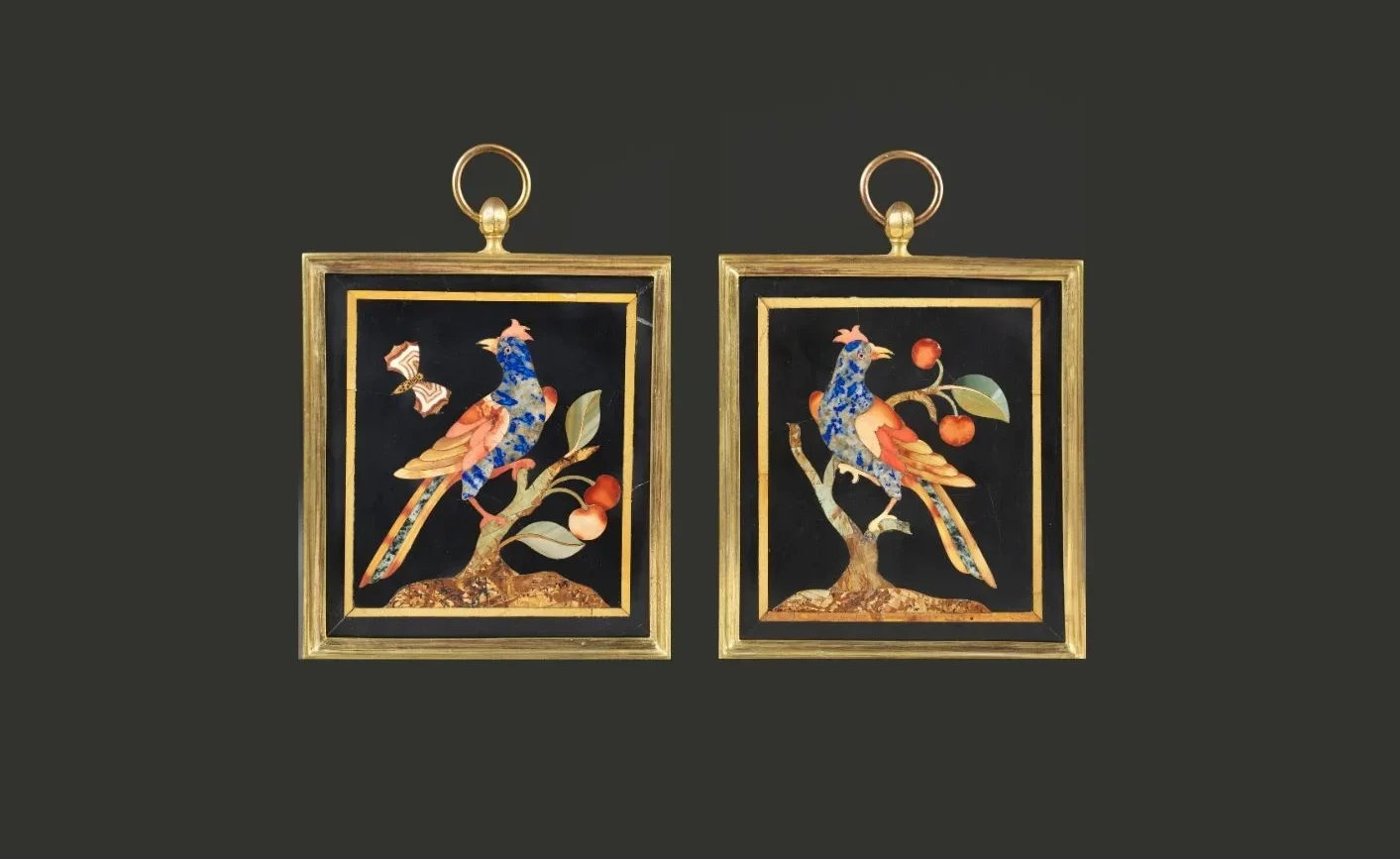
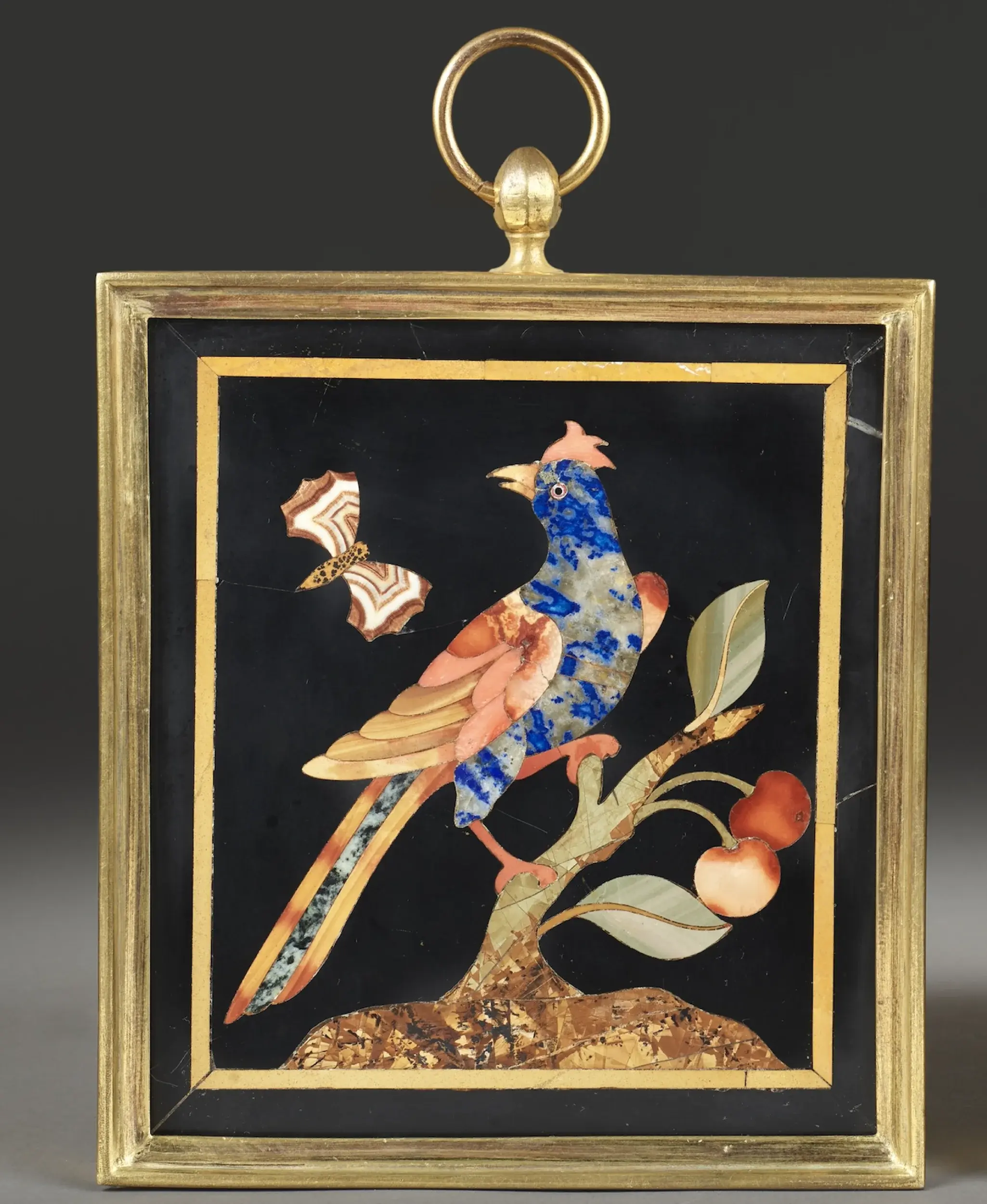
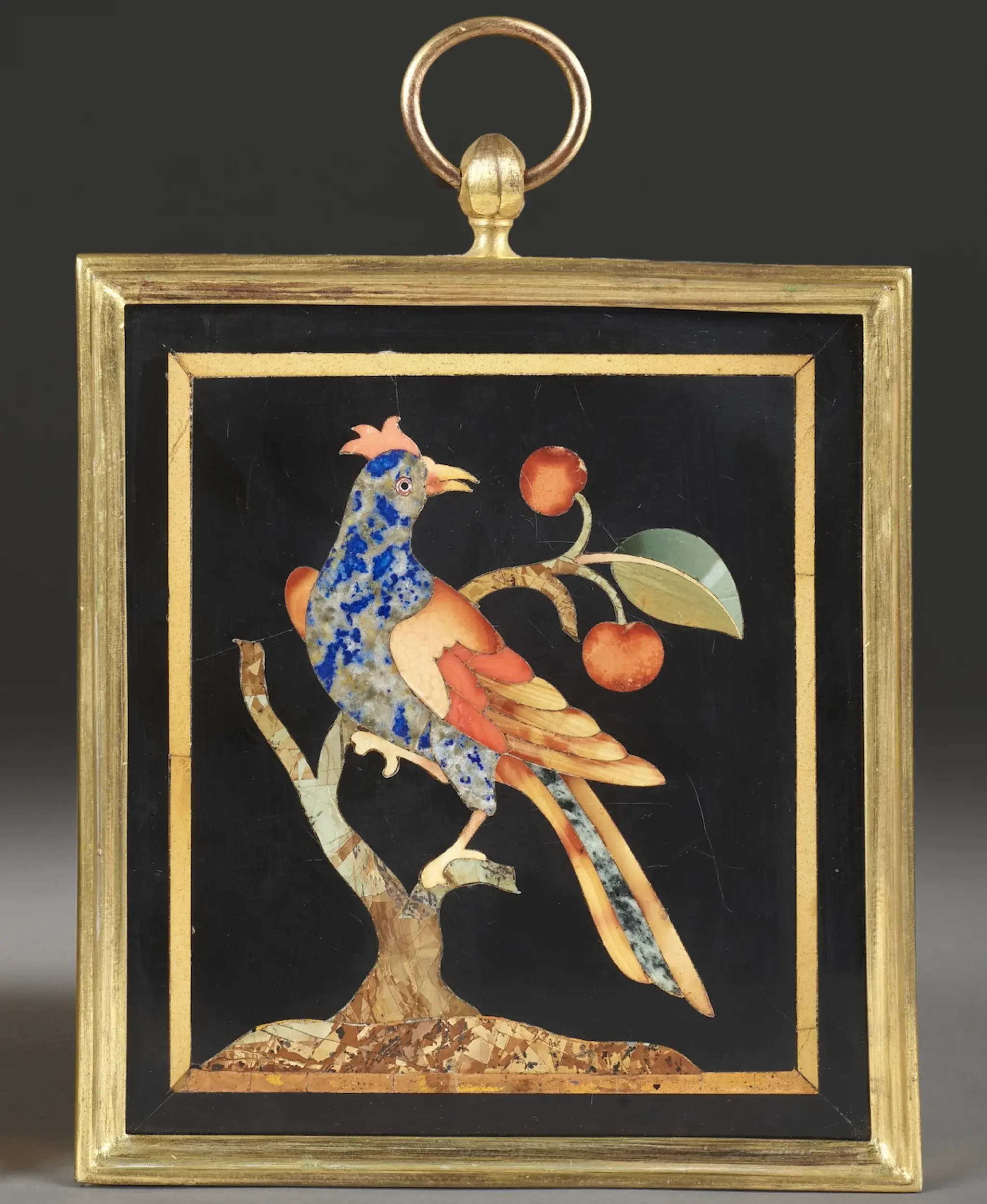
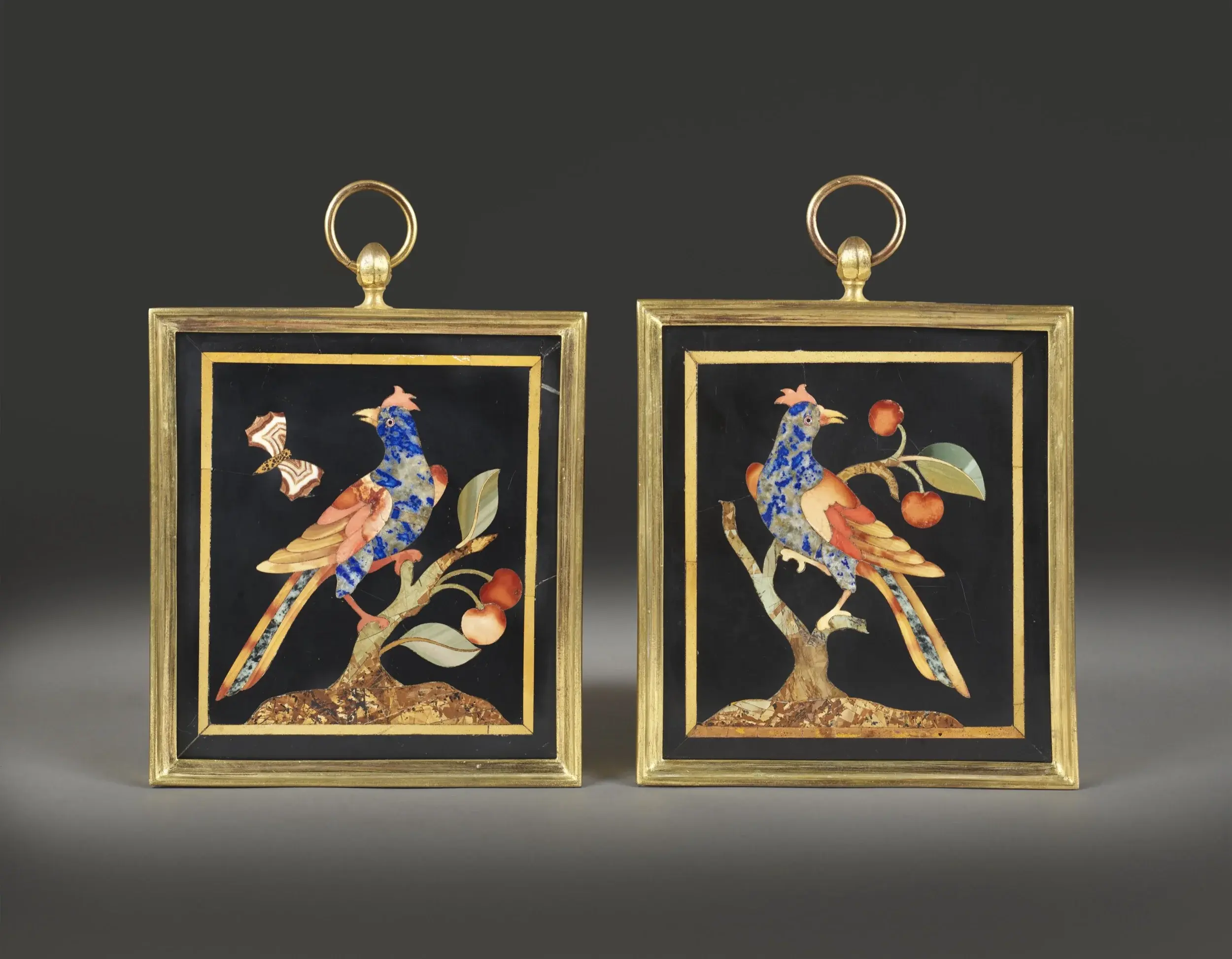
These two rectangular plaques, crafted using hardstone marquetry — including lapis lazuli, agate, and jasper — alongside polychrome marble inlays, depict a bucolic scene animated by birds in a natural setting.
Each panel portrays a bird of the same species, reminiscent of the blue jay, perched gracefully on a cherry tree branch bearing both leaves and fruit. In one of the panels, a delicately rendered butterfly in flight enriches the composition.
The refinement of the execution lies in the particularly sophisticated selection of stones in varied hues, allowing for a virtuoso rendering of volume, shadow, and texture. Variations of red suggest different stages of cherry ripeness, while the vibrant flashes of lapis lazuli evoke the iridescence of the bird’s plumage.
Techniques of Pietra Dura
A descendant of ancient stone engraving traditions — such as intaglios and carved gems — the
art of hardstone work in Italy belongs to a long-standing lineage. From the Renaissance onward, Florentine marquetry developed into two distinct techniques: intarsia and commesso. Though technically related, they differ in how the stones are set into the support.
Intarsia involves inlaying stone fragments of varied shapes and colors into a recessed base — most often marble — which is pre-carved to accommodate the individual pieces. The partially visible ground serves as a structural matrix, revealing the design’s segmentation. In the case of tabletop decoration, iron reinforcements are sometimes added along the borders to ensure stability. The pair of panels presented here was executed using this technique.
Commesso, by contrast, refers to a stone mosaic where elements are precisely cut to fit edge- to-edge and adhered to a concealed backing. Typical of Florentine Renaissance production, this method aims for a seamless surface. During assembly, the pieces are held in place with a clamp, and a plaster-based filler is applied around the motif to stabilize it before removal. The decorated surface is then meticulously polished, first with stone, then with lead.
The process begins with a modello, or preparatory sketch, entrusted to an artist. This can be done in oil on canvas or watercolor on paper. The design is transferred to a tracing, which serves as a matrix to divide the image into distinct sections — each corresponding to a specific stone or group of stones to be cut.
Stones are sawn into slices 2–4 mm thick. Cutting is performed with a bow saw made of a bent chestnut branch strung with wire, moved in conjunction with a wet abrasive (often sand) and a small metal spatula. The artisan selects stone veins carefully to match the desired hues, shadows, and textures. A sample is glued onto the tracing to guide shaping.
In the case of intarsia, as here, cavities are carved in the marble base to receive the stones, with the ground left deliberately rough for better adhesion. Originally, translucent white marble plaques were used, sometimes backed with metallic foil to enhance luminosity. Once the stones are adjusted, they are first affixed with plaster to level the reverse using abrasives. Final adhesion is done with a heated mixture of beeswax and rosin. The plaster is removed, and the surface is finely polished using wet abrasives and lead sheets.
The precision required for these techniques entails exceptionally long production times. For instance, the Tribuna table at the Uffizi in Florence took eleven years and a team of ten specialized artisans to complete.
The present pair of plaques exemplifies a craft founded on meticulous material selection. Each stone was chosen not only for its color but also for internal nuances, using natural veining to suggest relief, shadow, and surface effects. Assembled with care, the plaques form a coherent and autonomous decorative composition.
The Art of Pietra Dura in 17th- and 18th-Century Europe
Most pietra dura panel production took place in Florence, under the patronage of the Grand Dukes of Tuscany from the late 16th century onward. In 1588, Grand Duke Ferdinando I de’ Medici founded the Galleria dei Lavori, the leading Florentine workshop specializing in hardstone craftsmanship. From the late 17th century to the 1730s, the institution fostered a notably vibrant production.
Panels created there were often intended as independent decorative objects — such as these — or integrated into cabinetmaking: on coffers, cabinets, or boxes. Today, examples can be found in Florence at the Pitti Palace, Uffizi Gallery, and Opificio delle Pietre Dure, as well as in the collections of the Metropolitan Museum of Art and the Getty Museum. The celebrated Badminton Cabinet, commissioned in 1726, is now housed in the Liechtenstein Princely Collections in Vienna.
By the 1650s, such furniture was highly prized across Europe. Dutch marchands-merciers frequently traveled to Italy, commissioning hardstone plaques and marbles to be adapted onto locally produced cabinets. Some Dutch cabinetmakers even settled and worked in Florence. Likewise, Augsburg dealers mounted such plaques on furniture by local artisans.
In Paris, the rising popularity and high cost of Florentine pietra dura cabinets inspired local cabinetmakers to compete. As early as the 1660s, artisans began incorporating imported plaques into French furniture. In 1659, Pierre Gole was commissioned by the Cardinal Mazarin to create two cabinets from Florentine marquetry panels, though the cardinal ultimately rejected the result.
Despite this initial failure, the initiative was taken up by Colbert, who, ever mindful of court expenses and desirous of cultivating an aesthetic befitting Louis XIV, was reluctant to rely on Florentine imports. In 1662, Louis XIV founded the Gobelins Manufactory in Paris, renamed in 1667 the Royal Furniture Manufactory, with the aim of centralizing crafts under the direction of Charles Le Brun (1619–1690). The institution brought together tapestry-makers, goldsmiths, sculptors, hardstone artisans, and cabinetmakers.
Italian-born cabinetmaker Domenico Cucci, who arrived in France in the late 1650s, became a central figure in this enterprise, leading a team that produced monumental cabinets for the king. These grand pieces, made for Versailles, fell out of fashion under Louis XV and were largely sold off around 1750. Dealers dismantled them and repurposed the plaques into smaller furnishings such as commodes and consoles, now found in the British and Swedish royal collections, at the Château de Versailles, and formerly among the Rothschild holdings. These reinterpretations were often executed by master cabinetmakers such as Martin Carlin (1730– 1785) and Adam Weisweiler (1746–1820).
Among the surviving examples, several feature iconography closely related to the plaques studied here. Birds were a frequent motif in Florentine workshops, showcasing the chromatic versatility of the stones used, particularly in depicting plumage — whether from real or imaginary species.
The writing table of the Duke of Brissac, made by Martin Carlin and preserved at the Château de Versailles (inv. VMB 13753), features six pietra dura marquetry plaques inset into the frieze. Each shows a bird perched on a fruit-bearing branch, accompanied by a flying insect. The frames are in yellow marble. Dated to the 17th century, the plaques originated from the Galleria de’ Lavori, Florence’s primary pietra dura center. The juxtaposition of a static bird with a dynamic insect, the treatment of feathers, and the vegetal context closely echoes the two present plaques, one of which also includes a butterfly.
Such representations of birds on fruit trees are typical of Florentine pietra dura production in the 17th and 18th centuries. While often mounted on cabinets, coffers, and armoires, a similar pair of framed plaques is held at the Museo dell’Opificio delle Pietre Dure, attesting to the practice of displaying them as independent pictorial objects. The Louvre Museum also houses a related example (inv. LAB 1107).
The Galleria de’ Lavori in Pietre Dure
Founded in 1588 in Florence at the impetus of Grand Duke Ferdinando I de’ Medici, the Galleria de’ Lavori in Pietre Dure was conceived as a prestigious workshop dedicated to the restoration of ancient hardstone objects and the creation of new compositions. The initiative served a dual ambition: to affirm the Medici dynasty’s cultural authority and to preserve a rare and demanding technical expertise.
Ferdinando I recruited local artisans, whom he rigorously trained them in this complex art, teaching them how to assemble precisely cut fragments of colorful stones into elaborate lapidary images. This technique — which may be considered a form of illusionistic mosaic — achieved a degree of refinement that at times rivaled the painterly arts.
Throughout the 17th century, the workshop focused primarily on embellishing the Medici funerary chapel in San Lorenzo, begun in 1605. In the 18th century, however, the studio’s reputation expanded beyond Tuscany, as pietre dure creations became prized among Europe’s princely courts. Artisans from the Galleria were commissioned to work for the continent’s most prestigious noble families. While other workshops existed at the time — in Rome, for example, or in Germany — Florence remained the leading center for figurative hardstone marquetry, particularly in depictions of birds or vibrant landscapes.
Renamed Opificio delle Pietre Dure in the mid-19th century, the institution underwent a major transformation, integrating principles of scientific conservation and restoration. Today, it continues to function as a public establishment under the Italian Ministry of Culture, combining artisanal heritage, technical innovation, and the transmission of knowledge. Through this continuity, the Opificio stands as both a premier restoration laboratory and a living witness to Florentine excellence in the field of hardstone marquetry.
Bibliography
- Daniel Alcouffe (ed.), 18e aux sources du design: chefs‑d’œuvre du mobilier 1650–1790, exh. cat., Versailles, Domaine de Versailles et de Trianon, 26 Oct. 2014 – 22 Feb. 2015, Dijon: éditions Faton, 2014.
- Stéphane Castelluccio, Les meubles de pierres dures de Louis XIV et l’atelier des Gobelins, Paris: Éditions Faton, 2007.
- Calin Demetrescu, Le style Louis XIV, Paris: Les Éditions de l’Amateur, 2002.
- Calin Demetrescu, Les ébénistes de la Couronne sous le règne de Louis XIV, Lausanne: La Bibliothèque des Arts, 2021.
- Galerie G. Sarti, Fastueux objets en marbre et pierres dures, London: G. Sarti Antiques Ltd., 2006.
- Pierre Kjellberg, Le Mobilier français du XVIIIe siècle: Dictionnaire des ébénistes et des menuisiers, Paris: Les Éditions de l’Amateur, 2002, p. 109.
Related products
-
A pair of ormolu wheat ears candlesticks
26 000 € -
Compigné painting depicting a view of the surroundings of Francfort-sur-le-Main
18 000 € -
Compigné painting representing a riverside landscape
18 000 € -
Compigné painting representing a view of Rome’s surroundings (Copie)
9 000 € -
Console table in carved natural wood with grape vine motifs
38 000 €

