Compigné medallion painting representing a medieval nordic citadel
- Description
- Histoire
France, second half of the 18th century
Attributed to Thomas Compigné
Pewter, gold and silver leaf
Gouache, colored varnish
Diameter with frame: 13 cm – 5 inches
Diameter without frame: 9, 5 cm – 3 1⁄2 inches
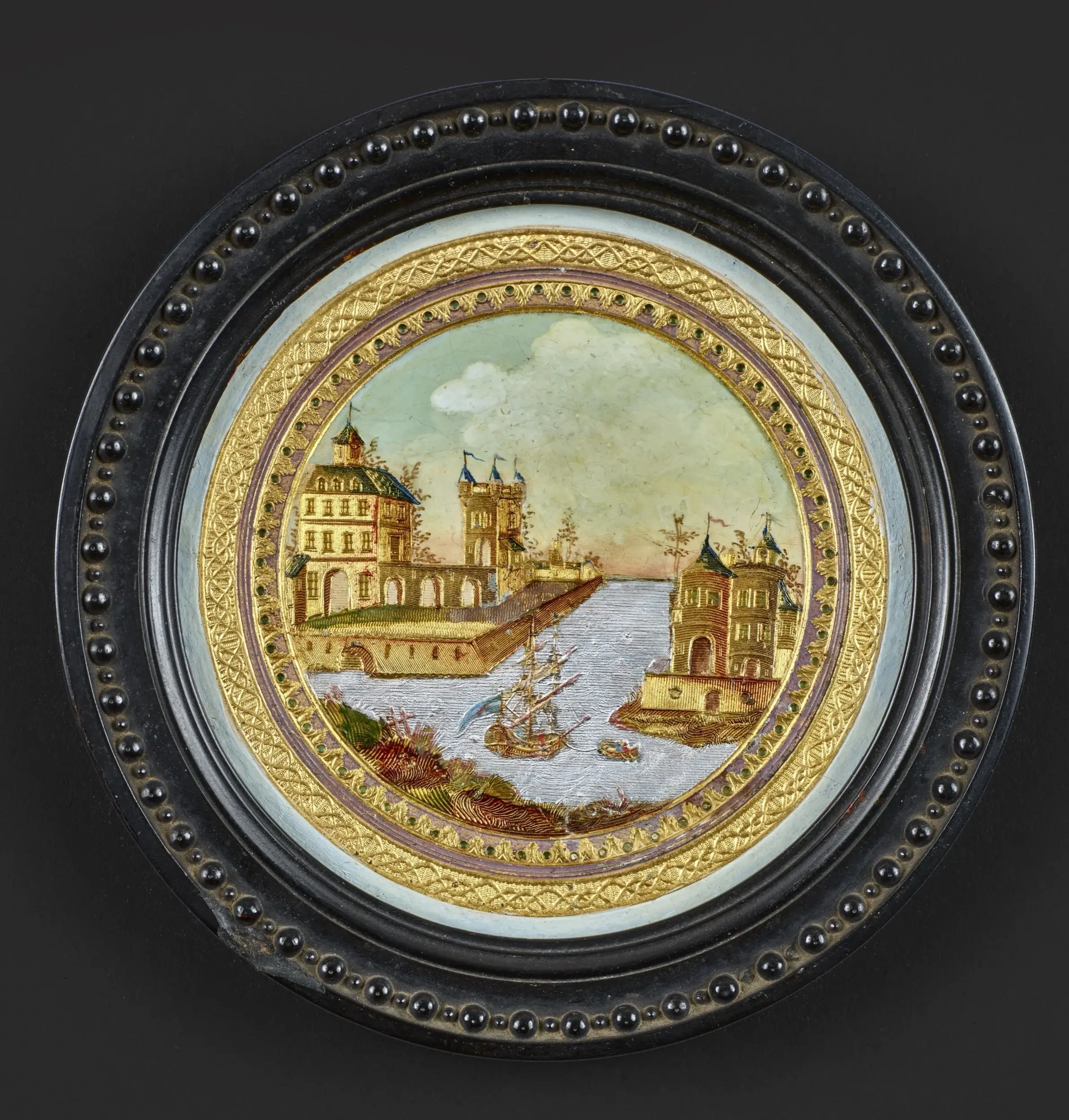
This Compigné painting depicts a citadel of a northern city, surrounded by canals.
Of modest size and circular shape, it is made of stamped pewter leaf enhanced with silver, gold leaf, and gouache.
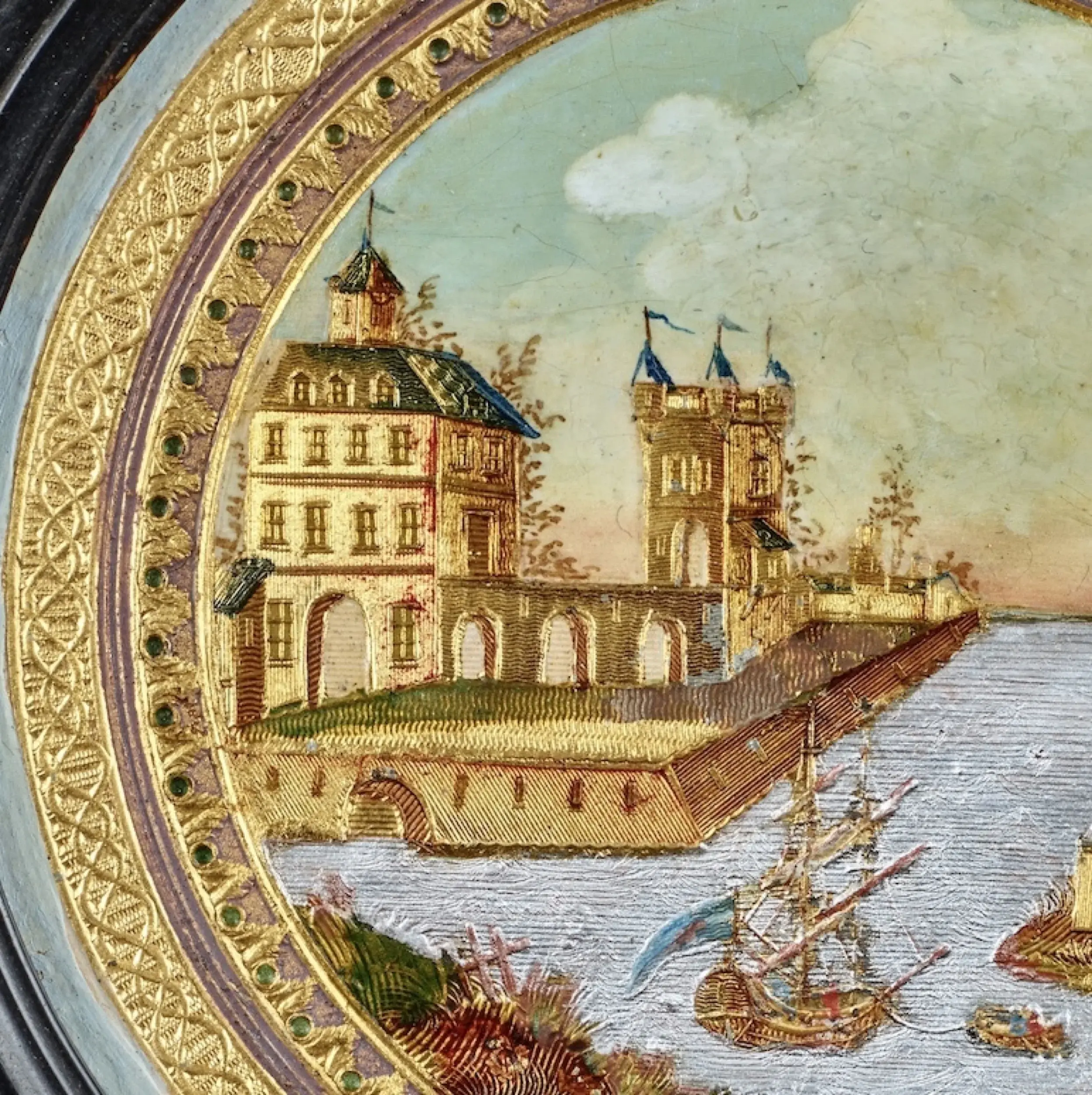
The scene depicts an earth median strip in the foreground, below which is a wide canal, forming the background, and extending in the central part of the painting to the horizon line, thus cutting the composition vertically in two. Stamped ridges on the water, highlighted with silver, evoke a flat and peaceful water on which a large two-masted sailing ship, bearing a blue flag and linked to a small boat.
On the bank to the left of this central canal is the part of the citadel that contains an early Renaissance castle, three stories high and covered with a four-sided roof pierced by dormer windows. At the top is a turret with a square base. Arcades, which certainly replace the old ramparts, lead to a cylindrical medieval keep on top of which are three small circular watchtowers with conical roofs above which float flags. An arched passageway pierces the keep in its depth.
On the opposite bank, medieval towers with conical roofs can be seen, their walls pierced with small rectangular windows. Each tower is also topped by a pennant floating in the wind.
Each detail of the architecture is rendered by a subtle surface work of pewter, enhanced with gold leaf. A few colored varnish additions on the roofs and pennants contrast with the whole, associated with the vegetation also colored.
In the background, a twilight sky with a few clouds is treated with gouache in a subtle gradation from pink to blue gray, by way of the milky white clouds.
The whole is surrounded by two stamped and gilded pewter friezes. The first one, quite thin, is presented on a background of a wine-red color. It is notched in teeth between which are small green brilliants. The second one, wider, has an interlace standing out on a background of edging. A thin wine-red band separates the two friezes.
Of great preciousity and variety of materials, the paintings in Compigné were made according to a mysterious process starting from a sheet of tortoiseshell or cardboard to which a pewter or gold leaf was applied. The surface could then be decorated with gold, silver, gouache and colored varnishes. These “miniatures”, known today under the name of Compigné, had a great success in the 1760s.The small format, characteristic of this production, required to work in extreme precision, probably with the help of a magnifying glass, to develop the perfection of these technical details and colors.
Bibliography
- Plaisir de France, « Les Compignés et leurs créateurs, ces délicats chefs‑d’œuvre de la tabletterie au XVIIIe siècle », n° 427, March 1975.
Compigné, peintre et tabletier du Roy, catalogue d’exposition, Grasse, Villa-Musée Jean- Honoré Fragonard, June-July 1991.
Related products

A pair of ormolu wheatears candlesticks
26 000 €Compigné painting depicting a view of the surroundings of Francfort-sur-le-Main
18 000 €Compigné painting representing a riverside landscape
18 000 €Painting in compigné depicting a view of the obelisk at Port-Vendres
9 000 €Painting in Compigné depicting the obelisk at Port-Vendres square
9 000 €