Pair of small « verre eglomisé » plates
- Description
- Histoire
France, 18th century
Gold, silver, and red pigments on verre églomisé plates
Gilt, chased, and openwork metal
Yellow curtains plate:
Height: 15 cm – 6 inches
Height (with frame): 18 cm – 7 inches Width: 11.8 cm – 4 2⁄3 inches
Width (with frame): 14.5 cm – 5 3⁄4 inches
Red curtains plate:
Height: 15 cm – 6 inches
Height (with frame): 18 cm – 7 inches Width: 11.2 cm – 4 1⁄3 inches
Width (with frame): 14.5 cm – 5 3⁄4 inches
Comparable example
- After Jean-Baptiste or Antoine Monnoyer, pair of verre églomisé pieces, first half of the 18th century, private collection.
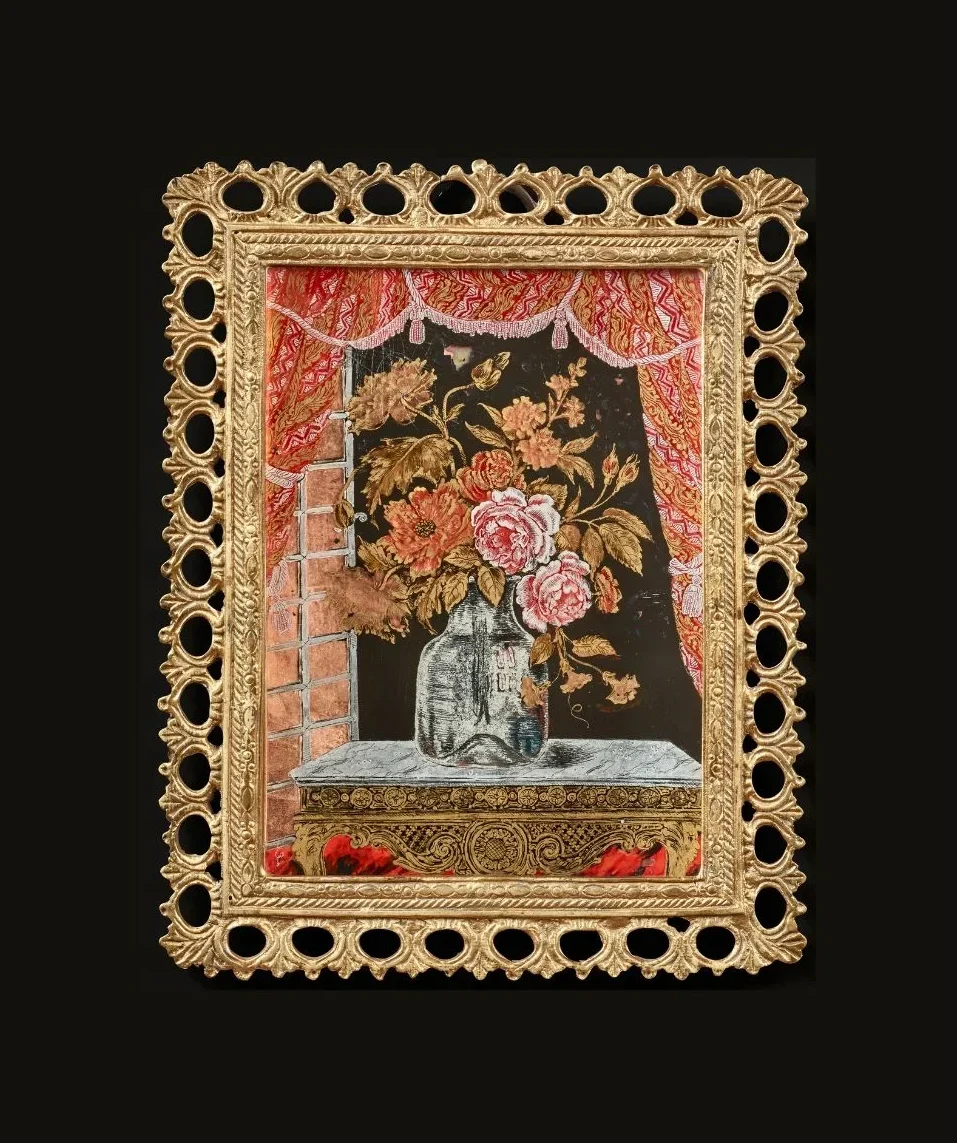
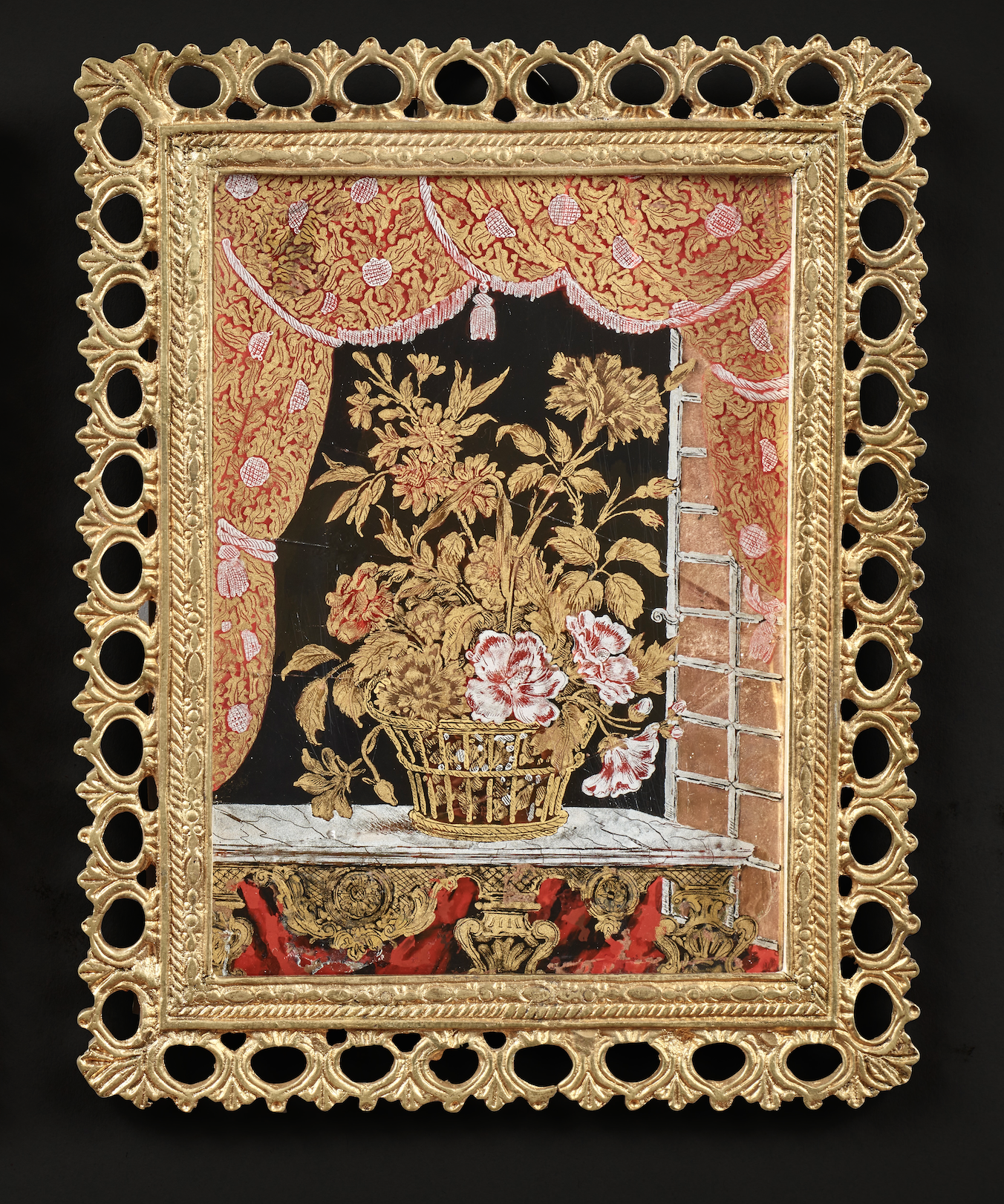
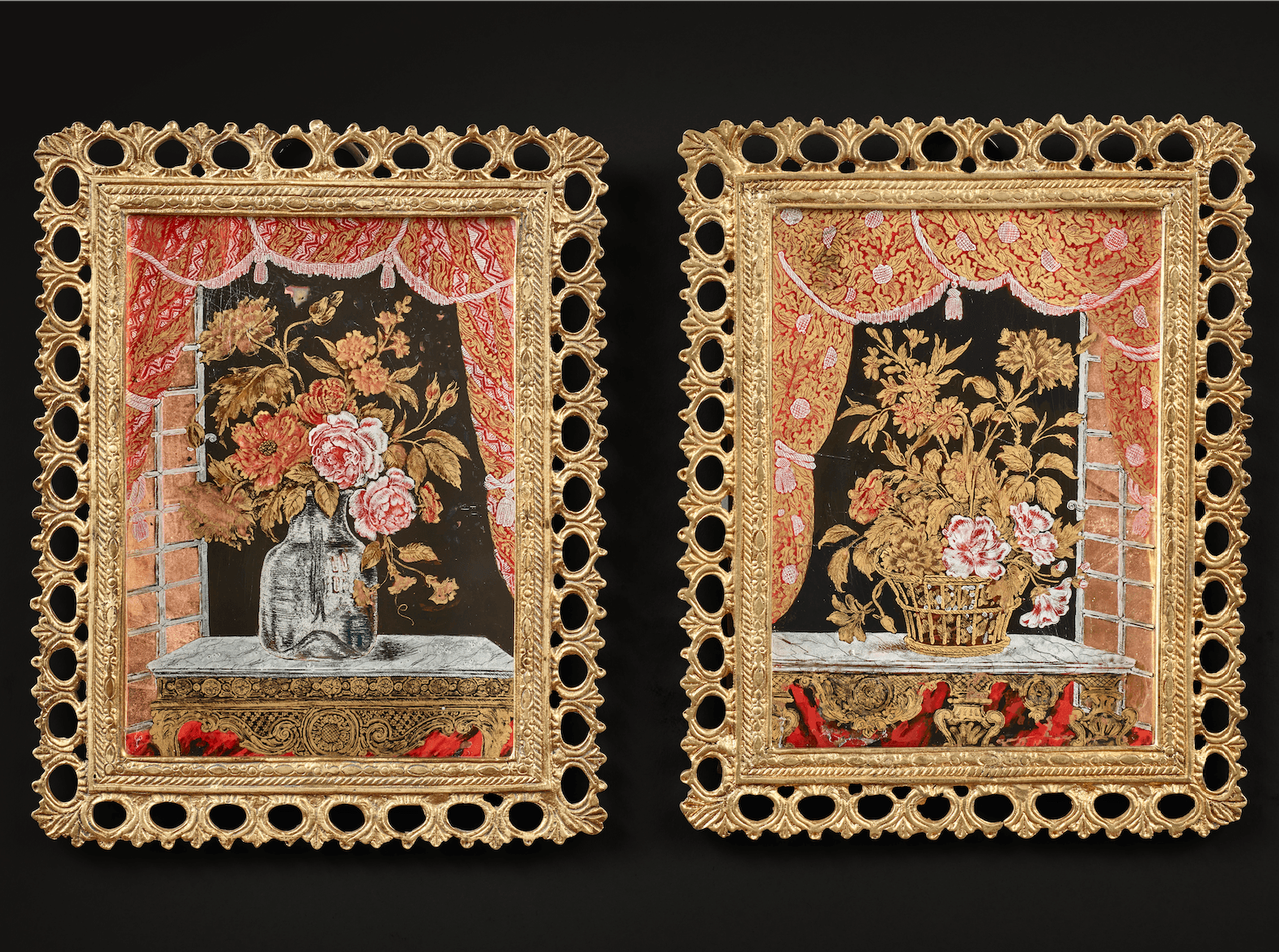
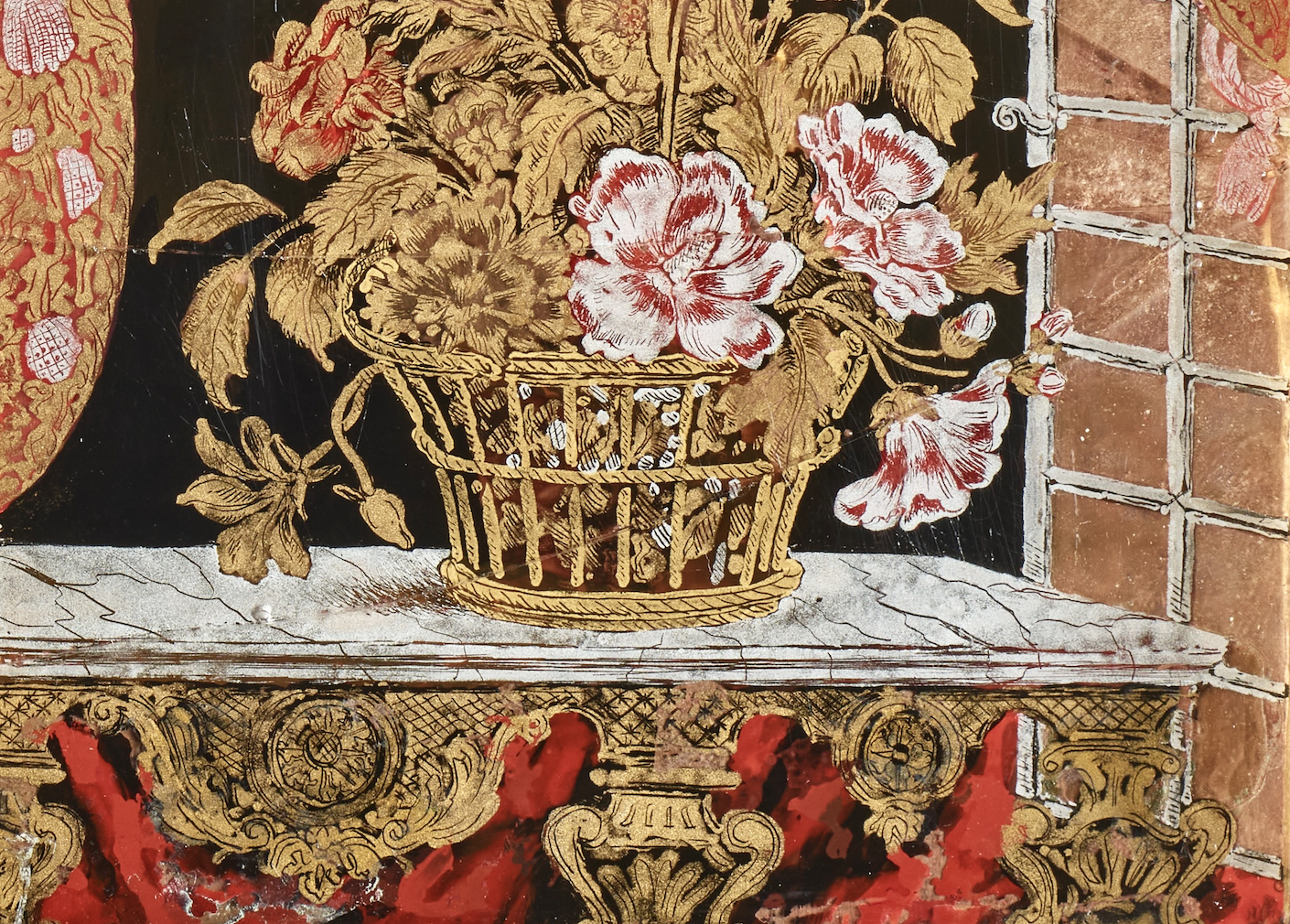
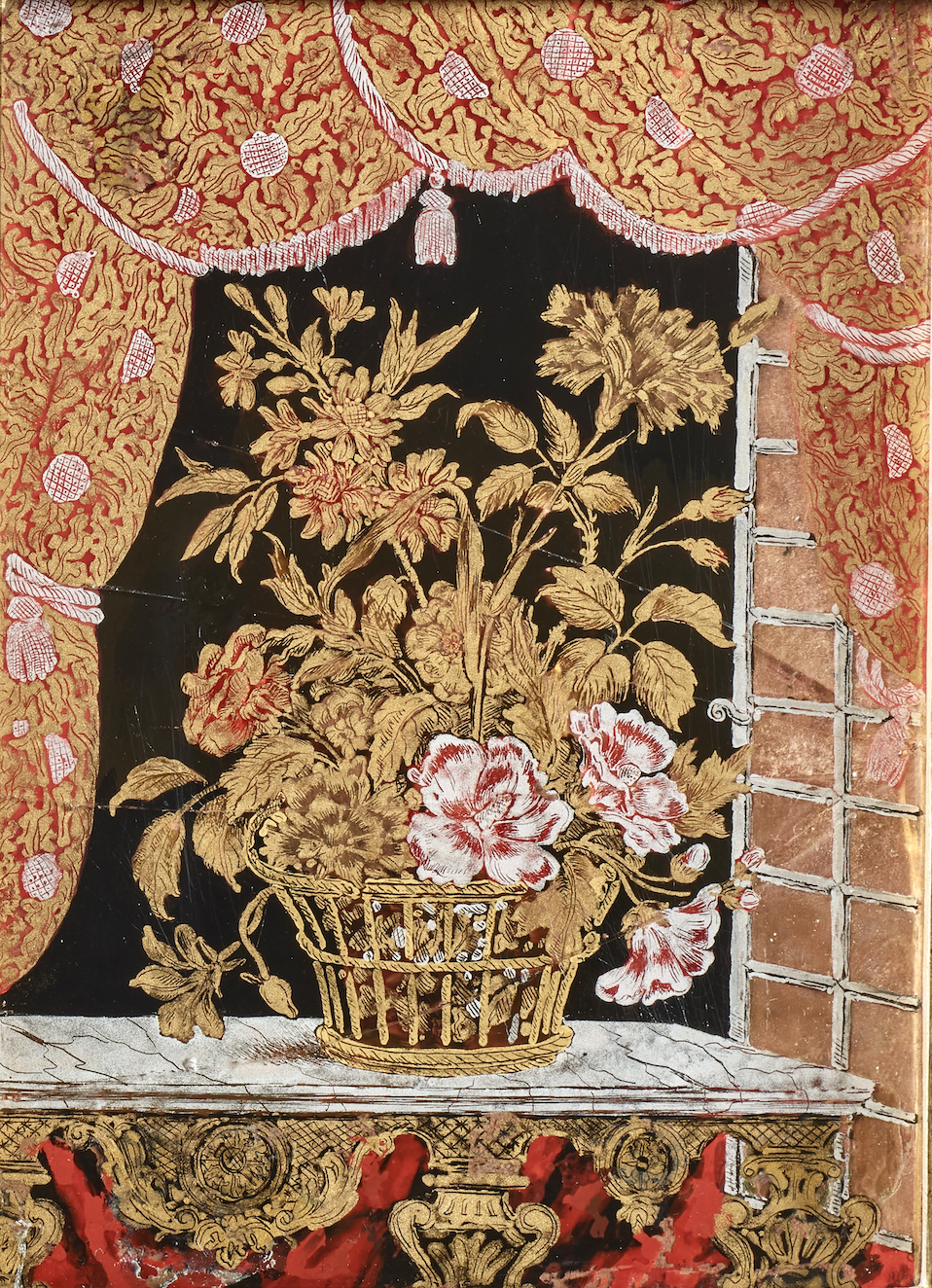
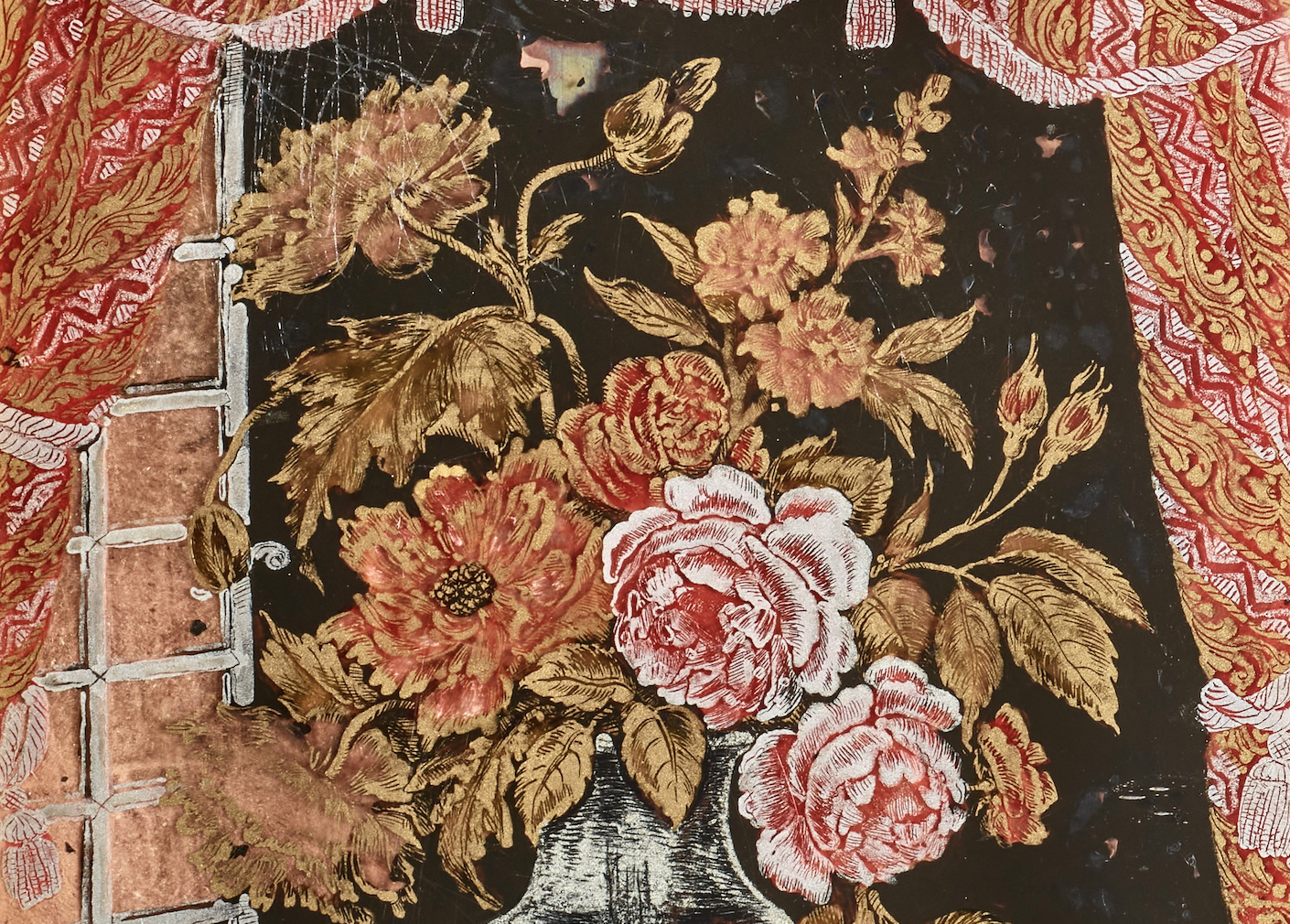
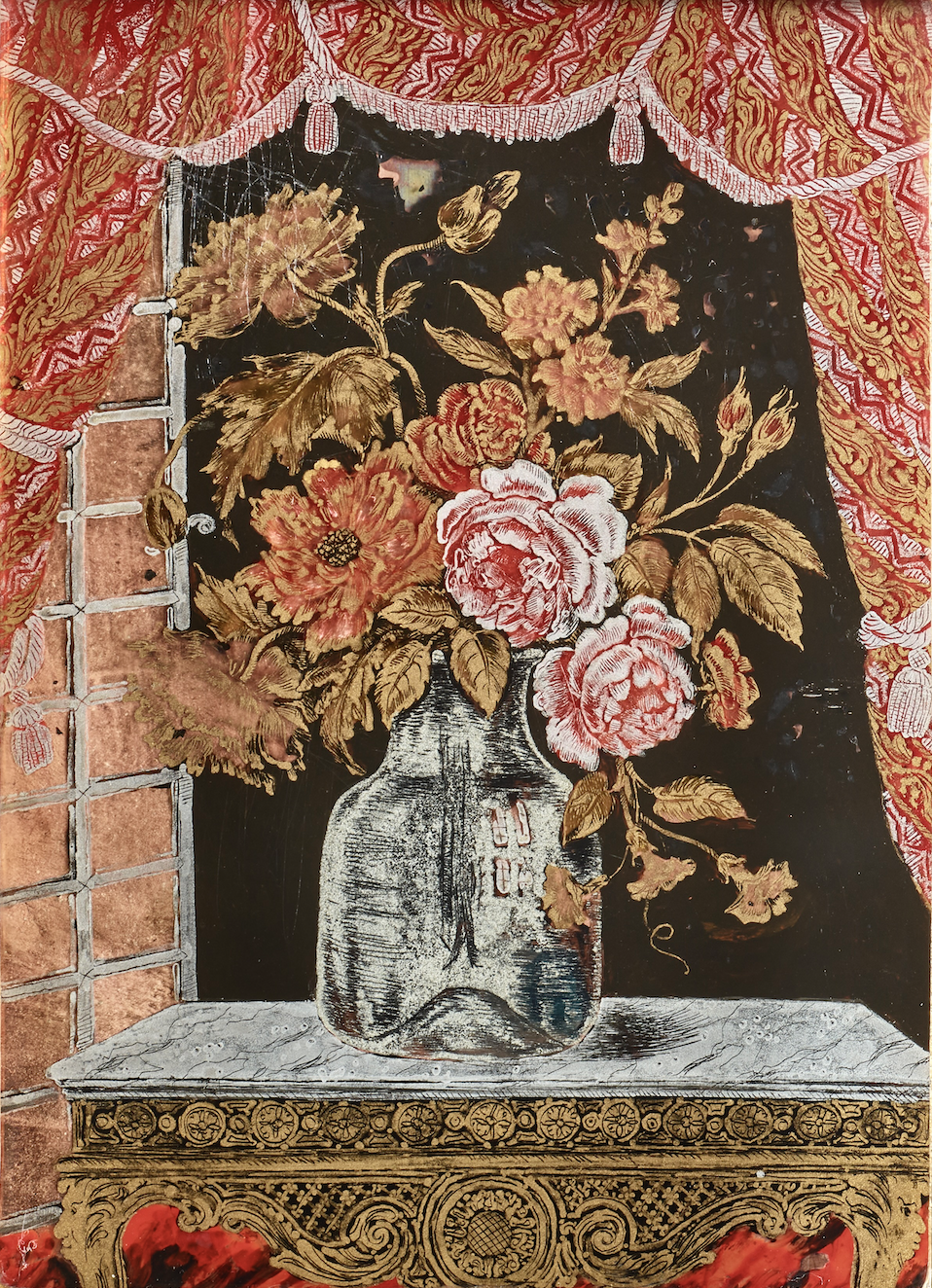
These two verre églomisé plates, set against a black background, each depict a majestic flower bouquet placed on a gilded wood console table with a white marble top, in front of an open window embrasure. The console tables are positioned against a wall with a red faux-marble finish. Rich red damask curtains with gold threads, acting as repoussoirs, frame each still life. Although similar in appearance, the two compositions differ in their details. On the first plate, where the open window embrasure appears on the right side of the composition, the first golden bouquet is arranged in a basket, standing on a console table typical of the Louis XIV period, as suggested by the distinctive baluster-shaped leg. The second plate presents a symmetrical composition to the first, with the window embrasure visible on the left. The bouquet is arranged in a glass vase, placed on a later console table, dated from the Régence period, what is identifiable by the masks decorating the tops of the console legs. These verre églomisé plates are remarkable for their rich composition, but also for their colors, which combines a range of red tones, white highlights, and gold leaf motifs. Each miniature painting is set/ housed in a finely chiseled and openwork gilt metal frame.
The verre églomisé technique
Appearing as early as the Roman era, the églomisé technique is a particular category of glass painting. It consists of decorating a glass plate on its worked reverse side, using gilding or different colors. The contours of the designs are drawn with an agate pencil, then the decoration is applied. It is not fixed with heat but is protected by another glass plate, a layer of varnish, or a layer of tin.
The process was used many times during the Middle Ages and the Renaissance. This technique was brought back to prominence by Jean-Baptiste Glomy (1711-1786), a print merchant, designer, engraver, and expert in sales in Paris in the 18th century. Associated with the merchant Helle, he published a catalog of Rembrandt's etchings. Glomy notably used this process to frame his engravings by surrounding them with a gold border, which later gave its name to the technique of gold-painted glass.
The technique of painting under glass, or rather "through the glass," should be said, since the subject is seen in transparency, is in itself already a huge challenge. The artist is forced to reverse the creative process, that is, from the foreground to the background, or even from detailed elements to the background. But mistakes are not allowed, as it is impossible to make any corrections to the subject painted on glass.
The Motif of the Flower Bouquet
Bouquets and baskets of flowers are a recurring motif throughout art history. Already represented in mosaics during Antiquity, this theme took on renewed significance during the Renaissance, particularly in the vanitas paintings of the Northern schools. These allegorical works, inviting reflection on the fragility of human life and the futility of human attachments, used fruits and flowers as symbols of time’s passing. Painted with naturalistic precision, they bloom and wither on canvas in a vibrant interplay of colors, light, and shadow, serving both as moral objects and demonstrations of artistic mastery—as illustrated by the oil on copper attributed to Ambrosius Bosschaert (inv. RF 1984 150), on display at the Louvre. Flemish masters excelled in this genre during the Golden Age.
In the early 18th century, bouquets and flower baskets gradually lost their symbolic dimension in favor of their decorative appeal. Nevertheless, the language of flowers remained a common visual code in paintings. Interest in arranged natural landscapes—such as the jardins à la française of Versailles— paralleled with advances in botany. Greenhouses and orangeries allowed exotic and European flowers to bloom year-round, which were then gathered into bouquets, that brought the garden indoors.
At the same time, the decorative arts became embraced artificial flowers, molded and painted from life. These floral designs appeared across a wide range of medium: marquetry, tableware, porcelain sculptures (e.g., Jean-Claude Duplessis and Claude Le Boitteux, Bouquet de la Dauphine, 1748, Dresden, Staatliche Kunstsammlungen, inv. PE 707), miniature paintings made from rare and diverse materials (mosaic, mother-of-pearl, shells), and tapestry. They also adorned precious small objects such as watches, snuffboxes, and fixé sous verre paintings like the verre églomisé pieces.
In the second half of the 18th century, Victor Vispré, a member of The Hague painters' guild, gained recognition for his still life paintings under glass. His works, purely decorative, were in highly sought after Paris. Sébastien Le Clerc, painter to the King, owned two; the Marquise de Pompadour had one; and Augustin Blondel de Gagny owned two as well.
These verre églomisé plates are particularly remarkable for their compositions, which recall 17th-century Northern still lifes arranged in niches, as well as for their shimmering colors.
Like real little paintings, these two verre eglomisé plates depict rich interior scenes. In a play of symmetry, a finely decorated apartment is described : sumptuous damasks trimmed with passementeries frame the scene, reminiscent of the most refined interiors of the time. Arranged on richly carved console tables, reflecting the contemporary productions of the greatest joiners, these bouquets take place in interiors typical of the Age of Enlightenment.
Bibliography
- F. Sydney Eden, “Verre églomisé”, The Connoisseur, no. 32, June 1932.
- Rudy Eswarin, “Terminology of verre églomisé”, Journal of Glass Studies, Vol. 21, 1975.
- Jeannine Geyssant, “Glass, Brilliance and Light: The Fascination and Charm of Reverse Glass Paintings.” Sèvres: Journal of the Society of Friends of the National Museum of Ceramics, no. 18, 2009, 50–56.
- Jeannine Geyssant, Berno Heymer, “The Enigma of the Vispré Brothers: Reverse Glass Painters in the 18th Century.” L’Estampille – L’Objet d’Art, no. 442, January 2009, 46–53.
- Paul Guth, “Toute la vérité sur le verre églomisé”, Connaissance des Arts, no. 66, August 1957, p. 28.
- W.B Honey, “Gold engraving under glass”, The Connoisseur, no. 92, December 1933.
- Julia Weber, David Babin, “La porcelaine au service de la diplomatie. Les échanges de présents entre Dresde et Versailles”, in Sèvres. Revue de la Société des Amis du musée national de Céramique, no. 16, 2007, pp. 51–56.
Related products

A pair of ormolu wheat ears candlesticks
26 000 €Compigné painting depicting a view of the surroundings of Francfort-sur-le-Main
18 000 €Compigné painting representing a riverside landscape
18 000 €Painting in compigné depicting a view of the obelisk at Port-Vendres
9 000 €Painting in Compigné depicting the port of Bordeaux viewed from the quai des Farines
9 000 €